Following along? Install Finmagine Trader first
Free NSE momentum scanner — no account needed • Chrome, Edge, Brave
Multimedia Learning Hub
Index Filter • MCap Filter • Score Filter • 39 interactive flashcards • YouTube video • Audio deep dive
Three Filters. Three Dimensions. One Precise Shortlist.
Open Finmagine Trader and the Stage 2 tab might show 150+ stocks. The All Three tab narrows it to 4–12. But even 12 stocks is a list, not a decision. The precision filters introduced in v1.2.0 solve the last mile: narrowing the best scan output to the names that match your strategy, your risk appetite, and today's market conditions.
- Nifty 50 — blue-chip only
- Nifty 100 — large-cap quality
- Nifty 200 — quality mid+large
- Nifty 500 — institutional universe
- ₹500 Cr — micro-cap floor
- ₹1,000 Cr — small-cap floor
- ₹5,000 Cr — mid-cap focus
- Up to ₹50,000 Cr mega-cap
- ≥1 — any signal present
- ≥2 — dual confirmation
- ≥3 — strong multi-signal
- =4 — maximum conviction
▶ From 161 Stocks to 4 High-Conviction Setups in 5 Minutes
A complete walkthrough of the three precision filters — how to use the Index Filter, MCap Filter, and Score Filter to go from a 161-stock list to a high-conviction shortlist before the market opens.
🎧 Audio Deep Dive: Mastering Precision Filters
A full audio deep dive covering every filter in depth — including the library analogy for server-side filtering, why the Nifty 500 is the “institutional universe,” the VCP speedboat analogy, and the orthogonality principle that makes stacking filters so powerful.
🎧 Mastering Finmagine Trader Precision Filters
Deep dive format • Q&A style • Detailed analogies and examples
Why server-side vs client-side changes everything about data integrity and count accuracy
Why FIIs and pension funds are legally restricted to the Nifty 500 universe
Why VCP patterns are structurally a small-cap phenomenon and never appear in mega-caps
Why stacking three independent filters creates precision, not redundancy
Test Your Knowledge — 39 Flashcards
Click any card to reveal the answer. Use the search to find specific topics.
🅾 The Signal-to-Noise Problem
Open Finmagine Trader on any trading morning. The Stage 2 tab might show 153 stocks. Near 52W High might show 59. High Volume might show 62. Even the All Three tab — the tightest intersection in the extension — typically surfaces 4–12 names on an average day.
That is already a dramatic reduction from 2,000+ NSE stocks. But 153 results is still a list, not a decision. You cannot research 153 stocks before the market opens. And you shouldn’t try to.
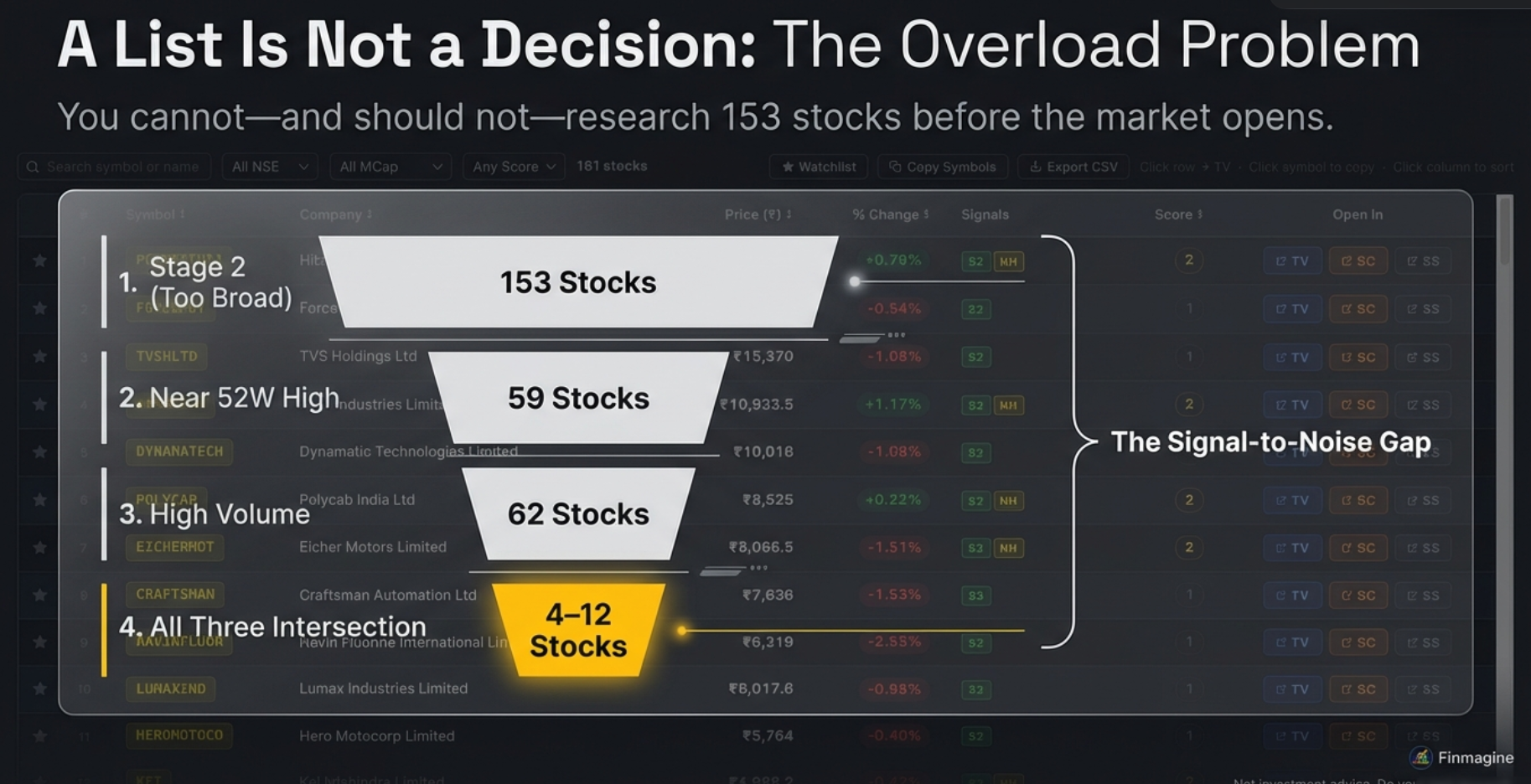
The funnel that brings 2,000+ NSE stocks down to 4–12 All Three candidates. The signal-to-noise gap is visible — the broad tabs surface too many stocks to act on, and even the All Three intersection still returns a list rather than a decision. That is what the three precision filters solve.
The question isn’t “which stocks pass the screener?” — it is “of those that pass, which ones fit my strategy right now?”
That is the job of the three precision filters.
“You trade nothing because you were shown everything.”
At 9:05 AM with the market opening in minutes, there is no time to check the sector, pull up a chart, read a recent announcement. The cognitive load is not just high — it is a paralysis trigger. Most traders end up doing one of two things: picking a name they recognise because the ticker sounds familiar (which is not trading, it’s gambling), or closing the extension and trading nothing at all because the cognitive load is simply too high. A list of 161 stocks is not opportunity. It is the paradox of choice in its most expensive form.
Index Filter
Controls the quality of the universe. Restricts scans to Nifty 50, 100, 200, or 500. Applied server-side — counts are always accurate for the selected index.
Server-sideMCap Filter
Controls the size of the universe. Sets a market cap floor from ₹500 Cr to ₹50,000 Cr. Match the screener size to your strategy.
Scan-levelScore Filter
Controls conviction. Shows only stocks where ≥1, ≥2, ≥3, or all 4 independent signals align. Instant — no re-fetch needed.
Client-side · Instant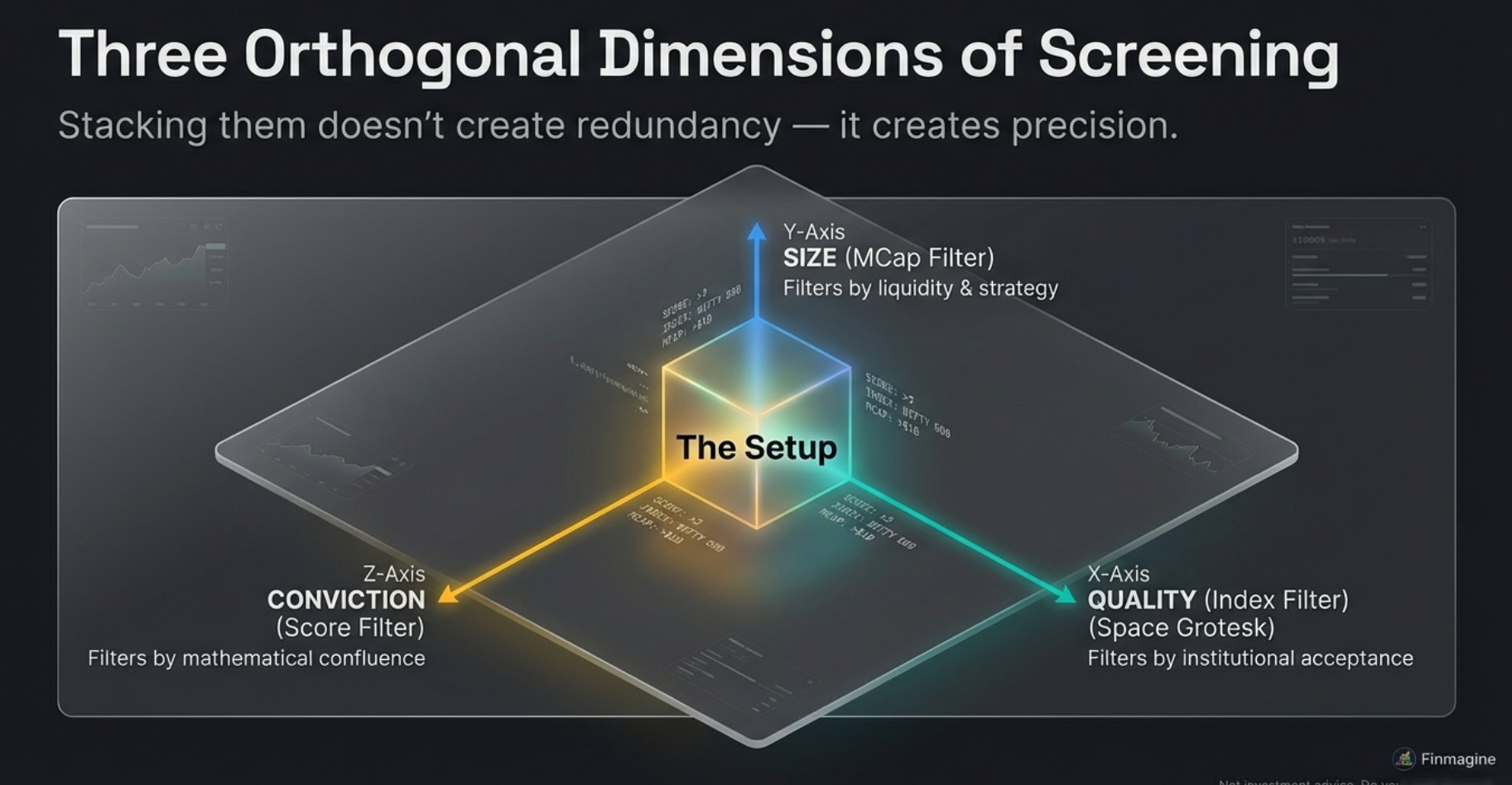
Three completely independent axes of filtering. Index = Quality (institutional acceptance), MCap = Size (liquidity and strategy fit), Score = Conviction (mathematical confluence of signals). Because each axis is orthogonal — measuring something entirely different — stacking all three creates precision without any redundancy.
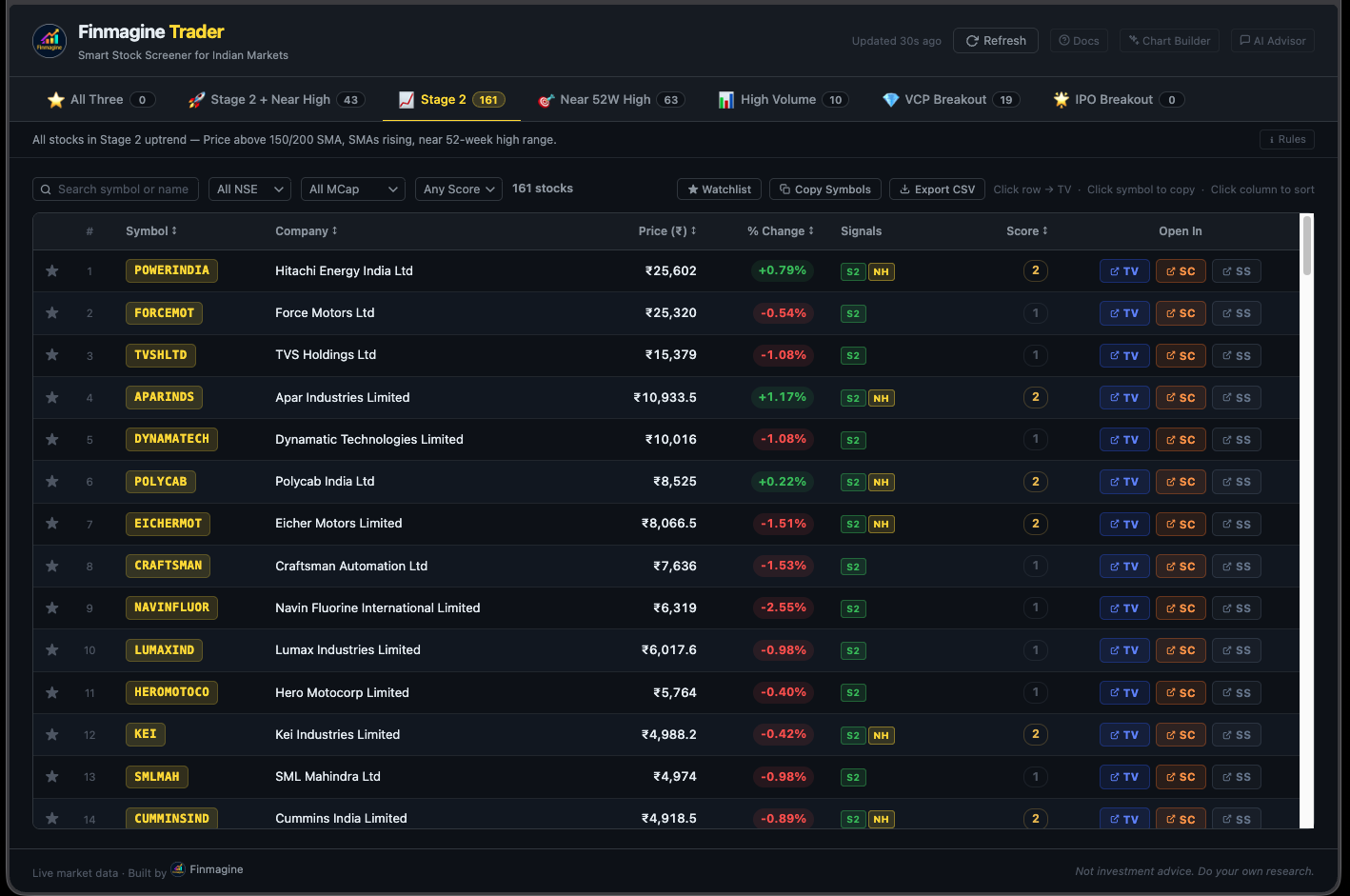
The Stage 2 tab with no filters applied — 161 stocks. A list, not a decision. The three precision filters solve exactly this.
🌍 The Index Filter: Quality by Association
When you apply the Index Filter, you are not filtering a results list — you are changing the scan itself. The filter is applied server-side, at the scan level, before any results reach your browser. The count you see is always accurate for the selected index.
The Four Index Tiers
| Index | Universe | What It Represents | Best Used For |
|---|---|---|---|
| Nifty 50 | 50 stocks | India’s blue-chip large caps. Highest liquidity, institutional ownership, analyst coverage. | Conservative momentum plays. Tight spreads, reliable volume signals. |
| Nifty 100 | 100 stocks | Nifty 50 + Next 50. Adds quality large-cap names just outside the flagship index. | Slightly wider while keeping a very high quality floor. |
| Nifty 200 | 200 stocks | Top 200 by market cap. Crosses into quality large mid-cap territory. | Swing traders wanting quality without large-cap-only restriction. |
| Nifty 500 | 500 stocks | Top 500 by market cap. Includes quality mid-caps. The standard institutional universe. | Default quality screen. Most traders start here before going wider. |
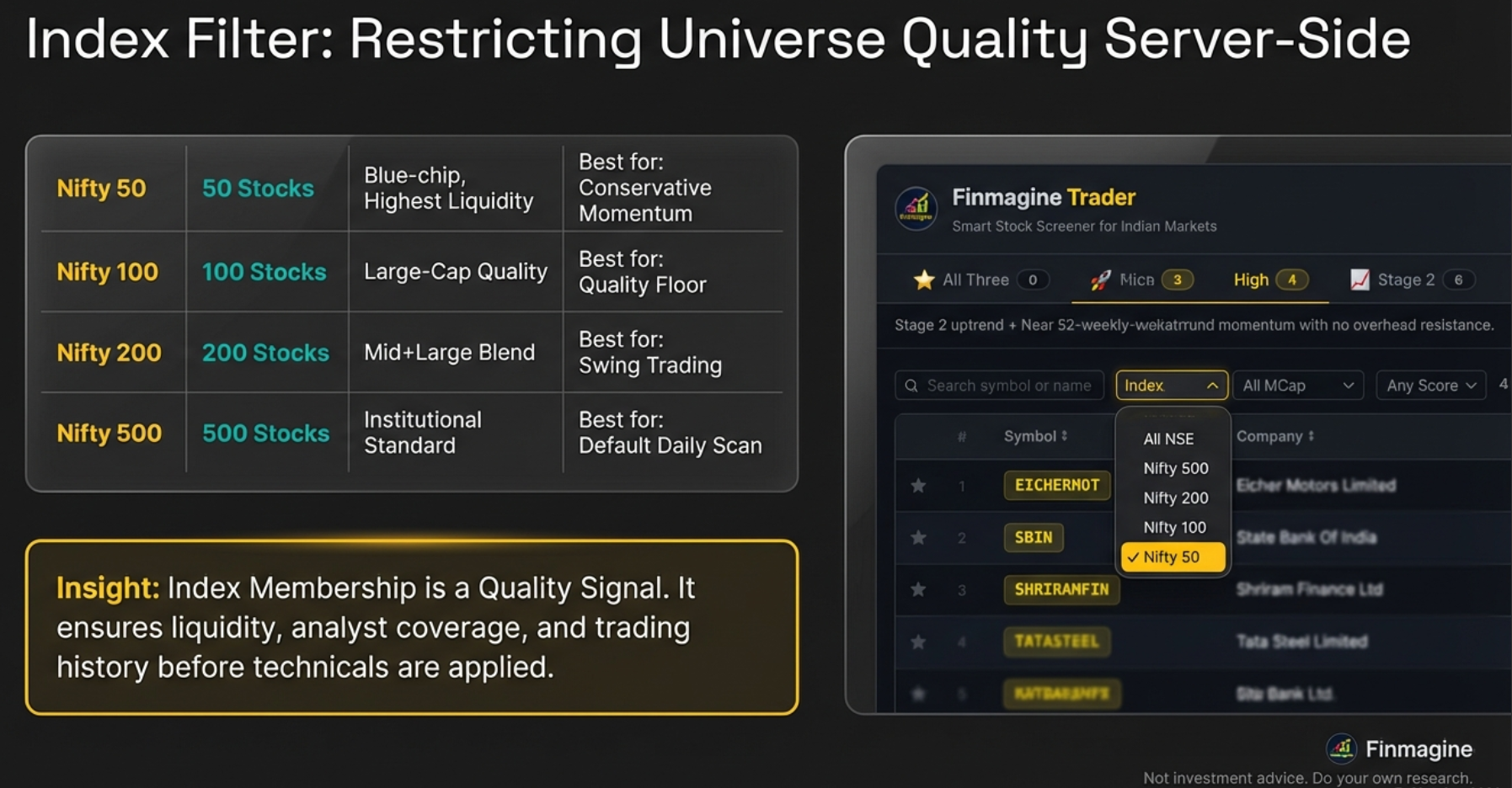
The four index tiers and when to use each. The critical insight shown in the bottom bar: index membership is itself a quality signal. Every stock in the Nifty 500 has passed NSE’s Index Maintenance Committee review for market cap, liquidity, and trading history — so your momentum criteria are applied to a universe that has already been pre-screened for viability.
Why Index Membership Is a Quality Signal
A Nifty 500 stock has passed periodic review by NSE’s index maintenance committee. It has sufficient market cap, liquidity, and trading history to qualify. It has analyst coverage, institutional ownership, and media attention. None of that makes it a good trade. But it does mean you are applying your momentum criteria to a universe of reasonably liquid, well-covered companies — reducing the risk of acting on a screener result where the signal is real but the stock is too illiquid to enter or exit cleanly.
The Nifty 500 as the Institutional Universe
The Nifty 500 matters for a reason beyond simple quality screening. It is the standard investment universe for institutional players in India — large mutual funds, pension funds, and foreign institutional investors. Many institutional mandates legally restrict fund managers from buying stocks outside the top 500 by market cap. The reason is liquidity risk: a fund deploying ₹500 Crore cannot enter a micro-cap without moving the price dramatically, or worse, being unable to exit cleanly when conditions change.
When you set the Index Filter to Nifty 500, you are effectively saying: “Show me the stocks where the big money is actually allowed to play.” That institutional presence means analyst coverage, quarterly earnings scrutiny, and genuine price discovery. When you see a momentum signal on a Nifty 500 stock, you can be confident it is real market activity — not a single operator painting the tape on a thinly traded name.
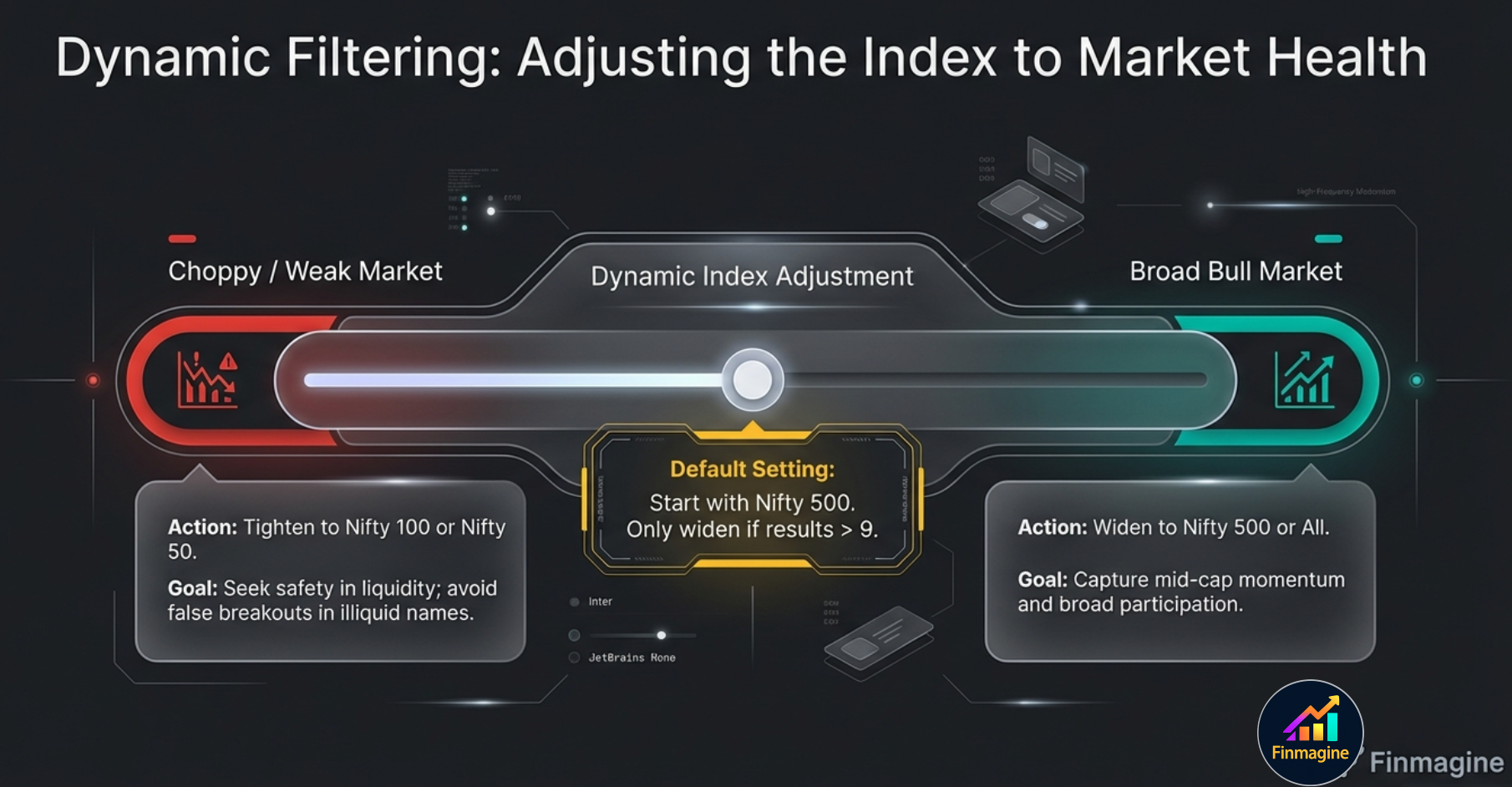
The Index Filter as a dynamic risk dial. Choppy or weak market conditions push you left — Nifty 100 or Nifty 50 for maximum liquidity safety. Broad bull markets push you right — Nifty 500 or All to capture mid-cap momentum. The default starting position is always Nifty 500: wide enough for opportunity, tight enough to avoid noise.
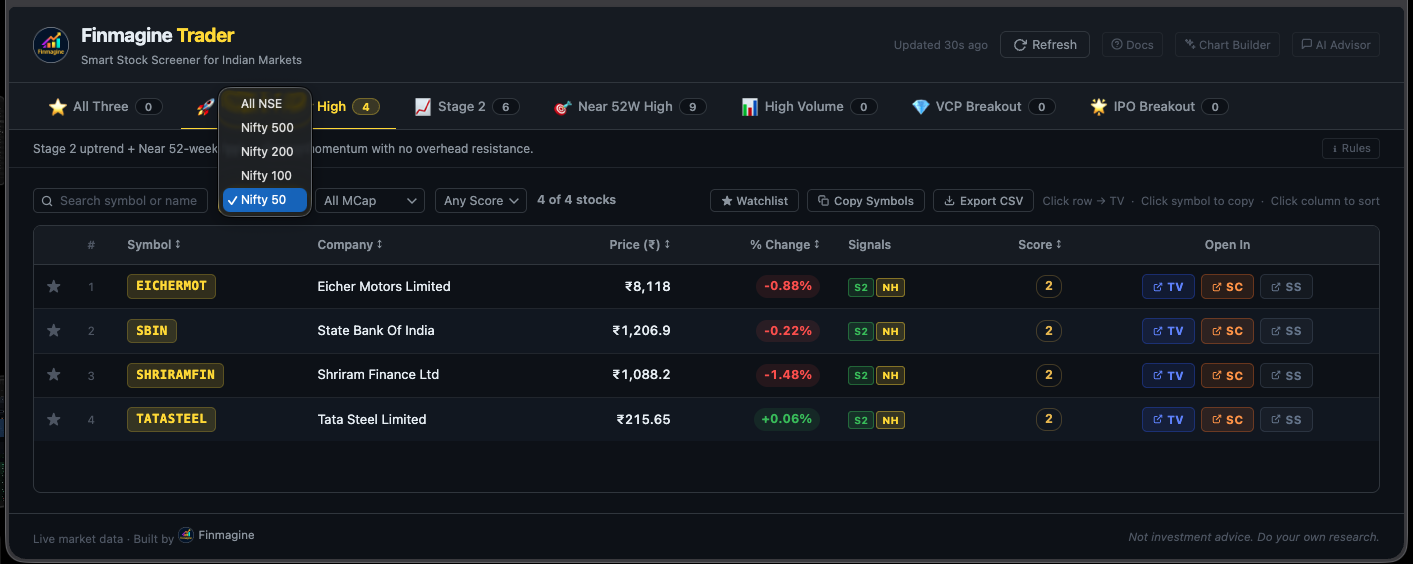
Index Filter set to Nifty 500 — server-side scan now restricted to the top 500 stocks by market cap. One dropdown, immediate universe quality lift.
💲 The MCap Filter: Match Size to Strategy
Different strategies work best at different market cap tiers. The MCap Filter sets a floor — stocks at or above the selected threshold are included. It lets you align the screener’s output to the specific size of stock your strategy is built for.
Available Thresholds
- All — No MCap restriction. Full universe for the selected tab and index.
- ≥ ₹500 Cr — Removes micro-caps. Minimum viable liquidity floor for most traders.
- ≥ ₹1,000 Cr — Small-cap floor. Filters out the smallest small-caps.
- ≥ ₹5,000 Cr — Mid-cap floor. Fastest way to reduce noise on the broad Stage 2 tab.
- ≥ ₹10,000 Cr — Large mid-cap and above.
- ≥ ₹25,000 Cr — Large-cap floor.
- ≥ ₹50,000 Cr — Mega-cap only.
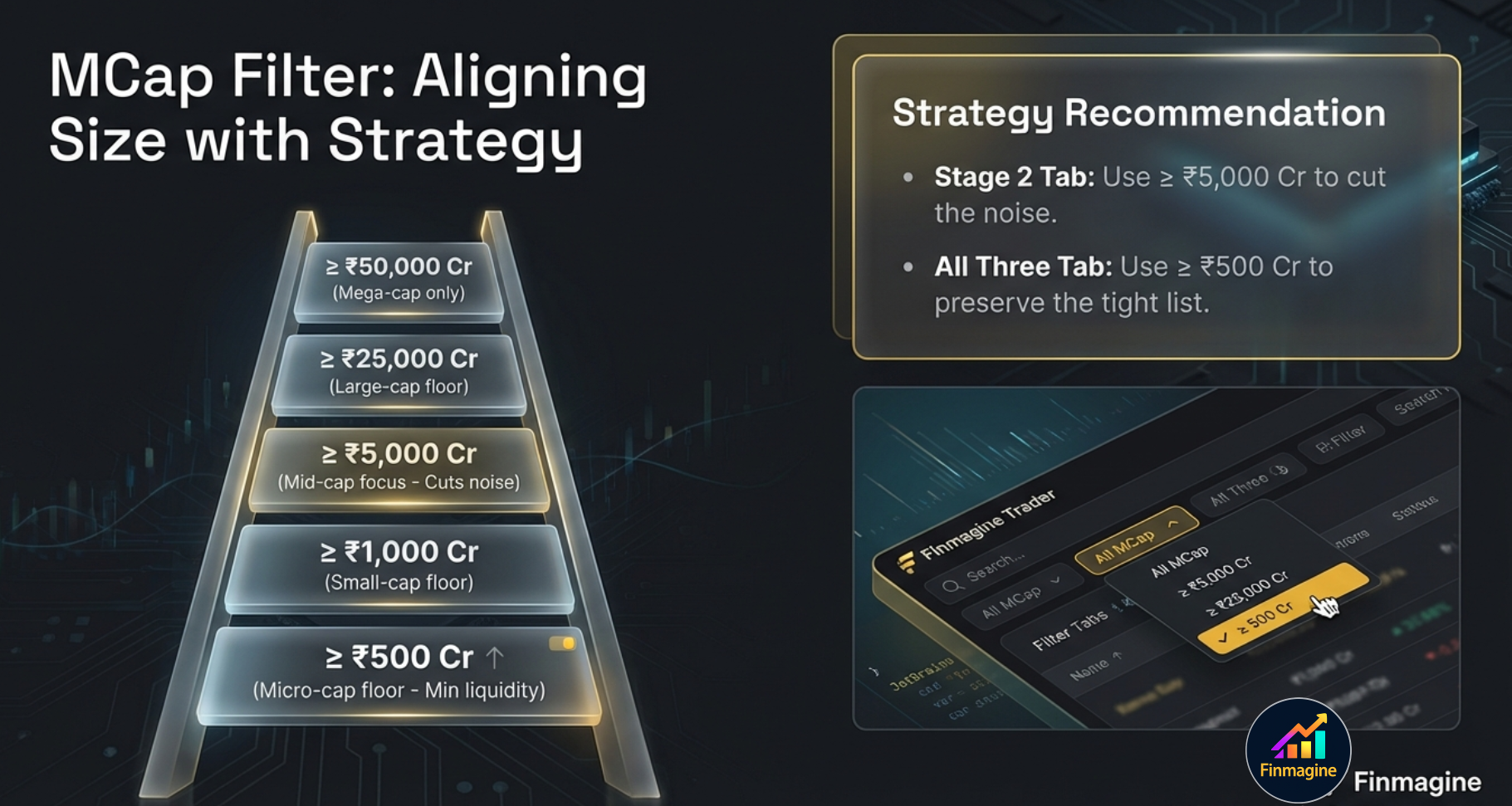
The MCap pyramid: six floors, each serving a different strategy. The two most commonly used levels are highlighted — ≥₹5,000 Cr for the Stage 2 tab (cuts the broad 150+ list down to quality mid-caps) and ≥₹500 Cr for the All Three tab (preserves the tight high-conviction list without over-restricting it).
Which Threshold for Which Tab?
| Tab | Suggested MCap Floor | Reasoning |
|---|---|---|
| ⭐ All Three | ₹500 Cr (or All) | Already the tightest intersection. Don’t over-filter a small list further. |
| 🚀 Stage 2 + Near High | ₹1,000–5,000 Cr | Good pre-breakout watchlist. Small-cap floor retains interesting setups. |
| 📈 Stage 2 | ₹5,000 Cr | Broad universe (150+). MCap floor is the fastest way to reduce noise. |
| 💎 VCP Breakout | All (or ₹500 Cr) | VCP already has a ₹30,000 Cr ceiling in the scan — small-cap by design. Don’t restrict further. |
| 🌟 IPO Breakout | All | IPO universe is inherently small/mid-cap. Keep the full universe. |
Why VCP Is Structurally a Small-Cap Phenomenon
The ₹30,000 Cr ceiling in the VCP scan is not arbitrary — it reflects a fundamental structural reality of how these patterns form. A Volatility Contraction Pattern requires a stock’s entire tradeable float to be absorbed quickly enough to create a tightening, decreasing-volume base. In a mega-cap, the float is enormous. Moving a company like Reliance Industries 20% in a few weeks would require billions of rupees of coordinated buying. It is an oil tanker: it trends, it grinds, it moves in synchrony with the broader market, but it does not coil and pop.
A small or mid-cap stock is a speedboat. Its float can be completely absorbed by just two or three institutional funds taking a position. That rapid absorption is precisely what creates the tight, decreasing-volume base that defines a VCP breakout. Applying a large-cap MCap floor to the VCP tab is not just ineffective — it is asking the scanner to find something that structurally cannot exist at that size.
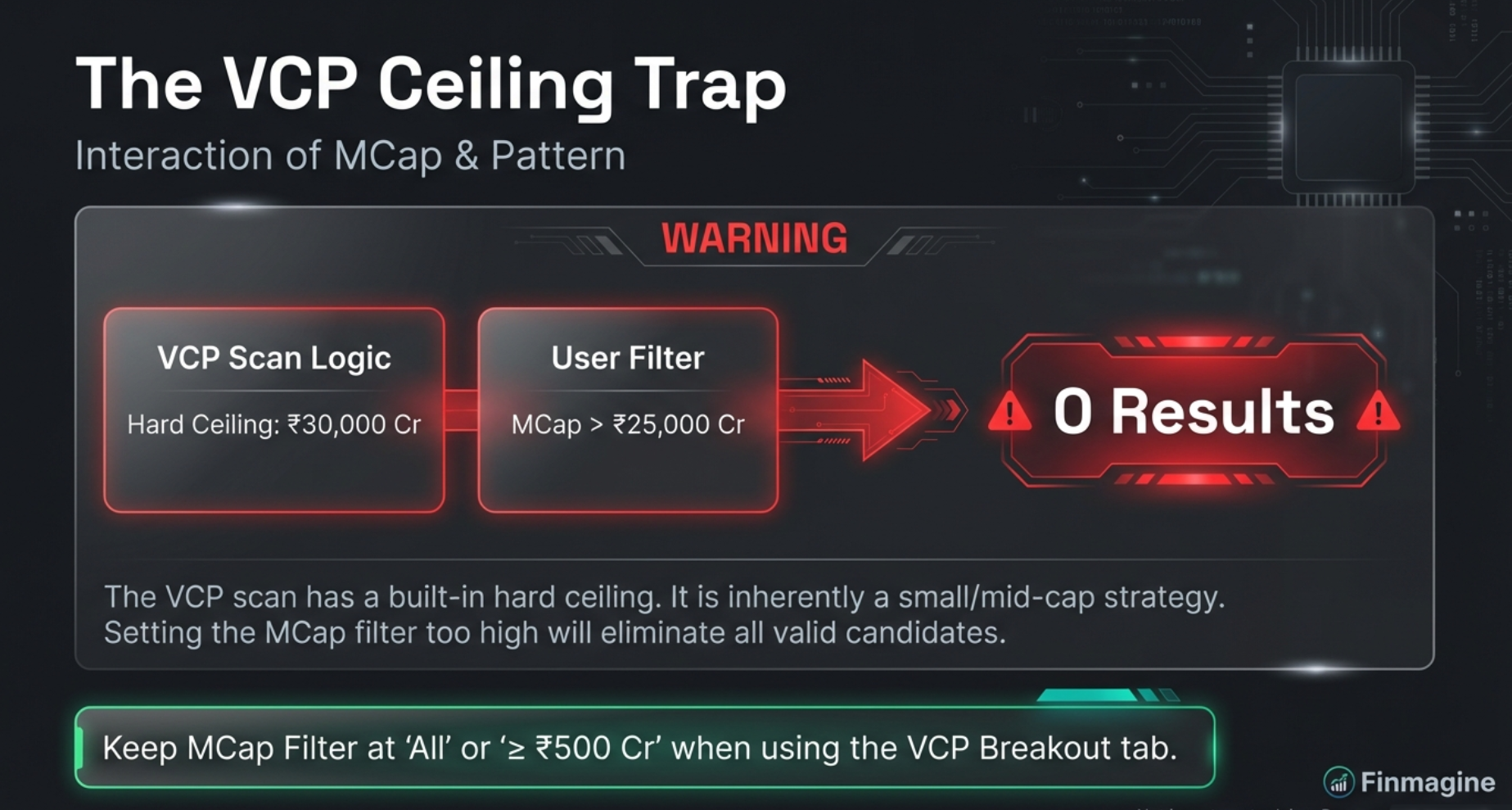
The VCP Ceiling Trap visualised. The VCP scan query already bakes in a ₹30,000 Cr hard ceiling. When you layer a high MCap floor on top, the two constraints overlap and produce zero results — not a bug, a logical impossibility. The fix is simple: keep MCap set to All or ≥₹500 Cr on the VCP Breakout tab.
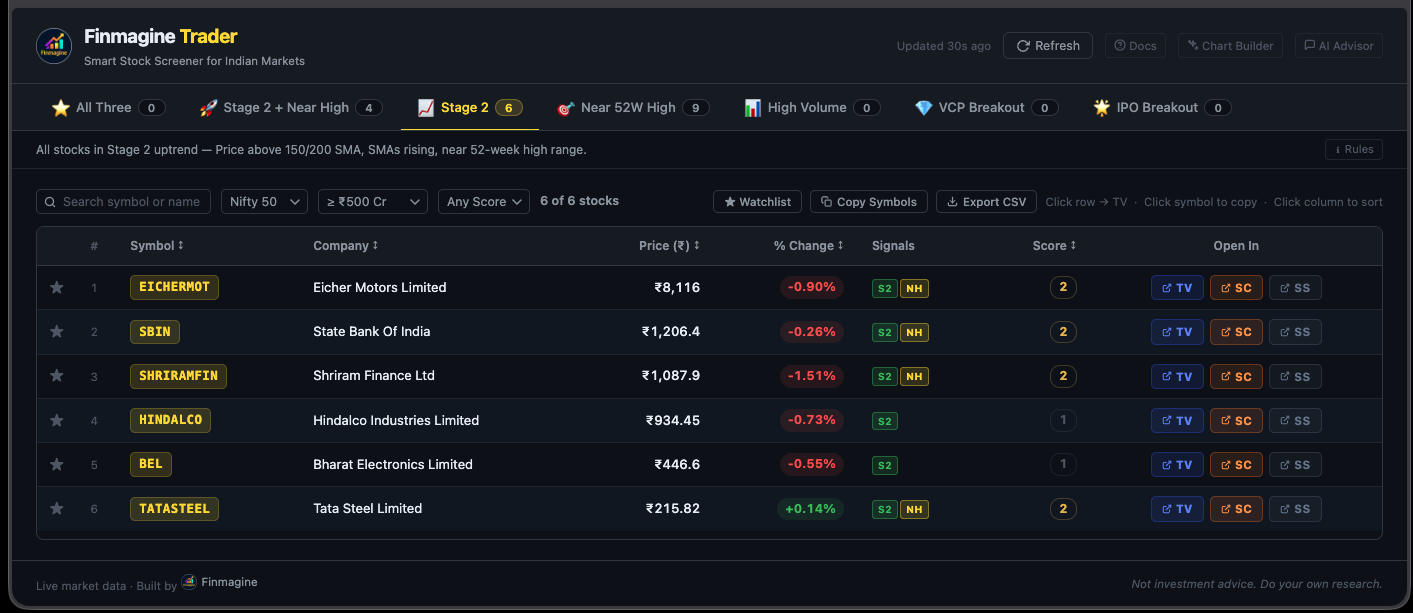
Two filters stacked — Nifty 500 (quality) + MCap ≥₹5,000 Cr (size). Because they operate on independent dimensions, the result is precision without redundancy.
🎯 The Score Filter: Conviction at a Glance
Every stock in Finmagine Trader carries a Score of 1 to 4 — a count of how many of the four independent signals (S2, NH, HV, VCP) it is simultaneously passing. The Score Filter lets you set a minimum conviction threshold. It runs client-side, instantly — no re-fetch to the server is required.
What Each Score Means
| Score | Signals Passing | Interpretation | Typical Count (All Three tab) |
|---|---|---|---|
| 1 | Any 1 of 4 | One signal confirmed. Informational — a single framework sees the stock. | N/A (All Three requires ≥3) |
| 2 | Any 2 of 4 | Two independent frameworks agree. Watchlist-worthy but not yet full conviction. | N/A |
| 3 | Any 3 of 4 | Strong multi-signal alignment. Stage 2 + Near High + either Volume or VCP. | ~10–20 stocks |
| 4 | All 4 signals | Maximum confluence. All four independent frameworks agree simultaneously. | 0–5 stocks |
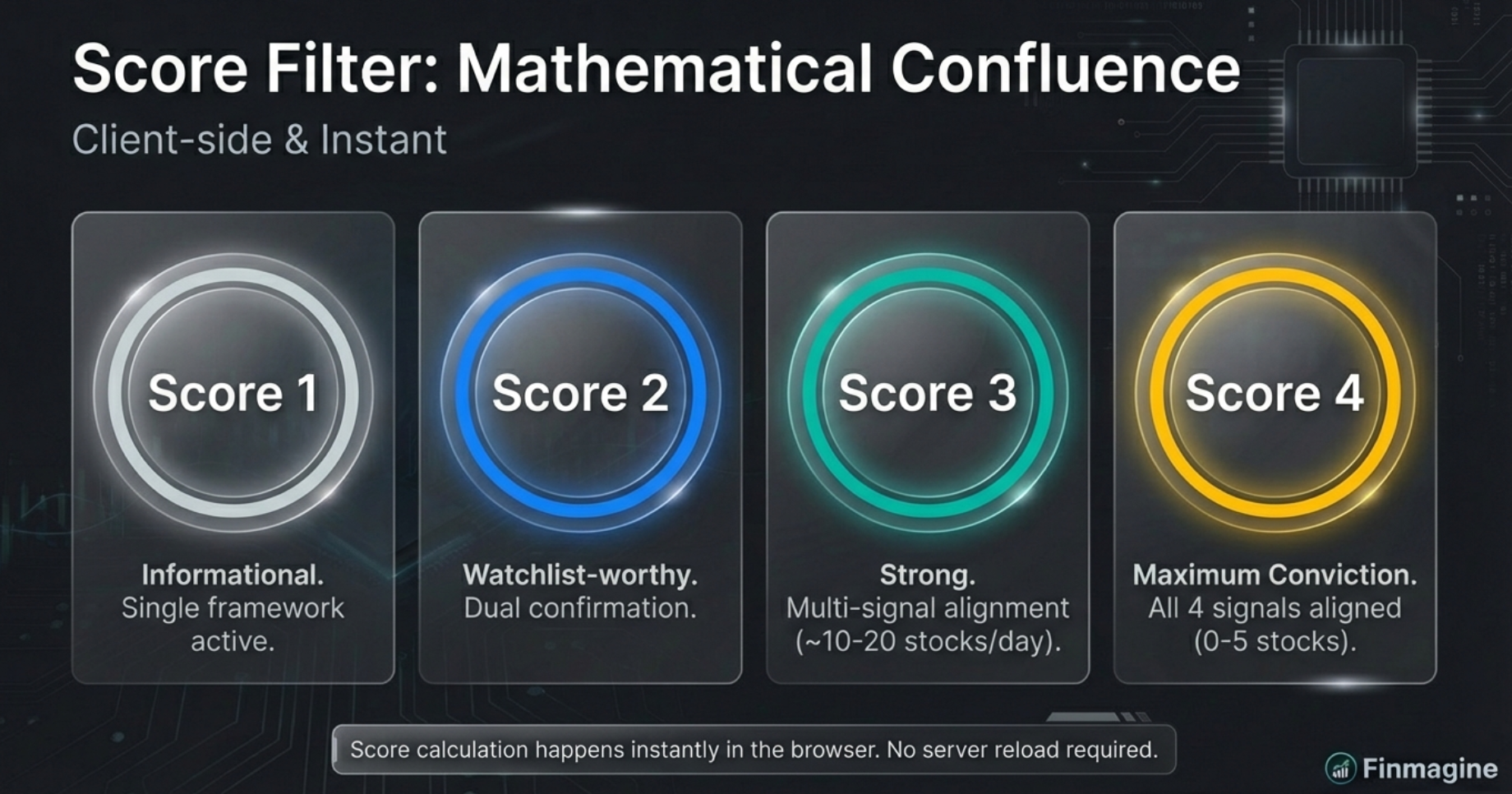
The four Score levels visualised as conviction dials. Score 1 (grey) = a single framework has noticed the stock — informational only. Score 2 (blue) = dual confirmation, watchlist-worthy. Score 3 (teal) = strong multi-signal alignment, typically 10–20 stocks per day. Score 4 (gold) = maximum conviction — all four independent frameworks agree, 0–5 stocks. The Score Filter runs client-side, so switching between levels is instant with no server reload.
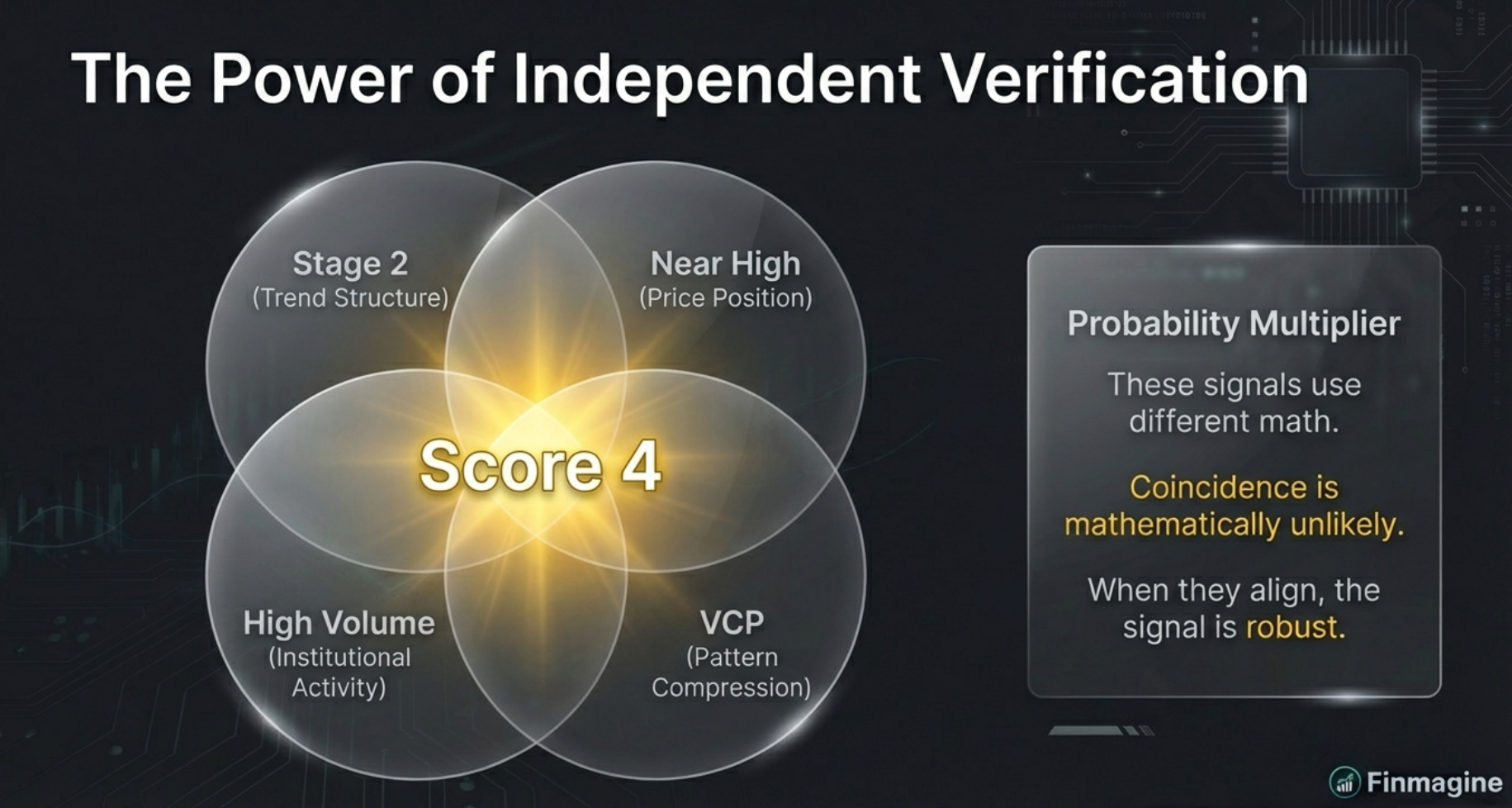
The probability multiplier behind Score 4. Each of the four circles represents a completely independent technical framework measuring a different dimension of the stock’s behaviour. Stage 2 = trend structure. Near High = price position. High Volume = institutional activity. VCP = pattern compression. These signals use different mathematics and different data. When all four independently arrive at the same stock on the same day, coincidence is mathematically unlikely. That convergence is exactly what makes the signal robust.
Score Filter on the Stage 2 Tab
The Score Filter is most powerful when applied to the broader tabs. The Stage 2 tab might show 150+ stocks — applying Score ≥ 2 immediately reduces this to stocks that are not just in a Stage 2 uptrend, but are also near their 52-week high, or on high volume, or in a VCP pattern. That is a very different — and much shorter — list.
On the All Three tab (which already requires 3 signals), applying Score = 4 shows only the subset that also has VCP compression — the tightest possible screen within an already-tight universe.
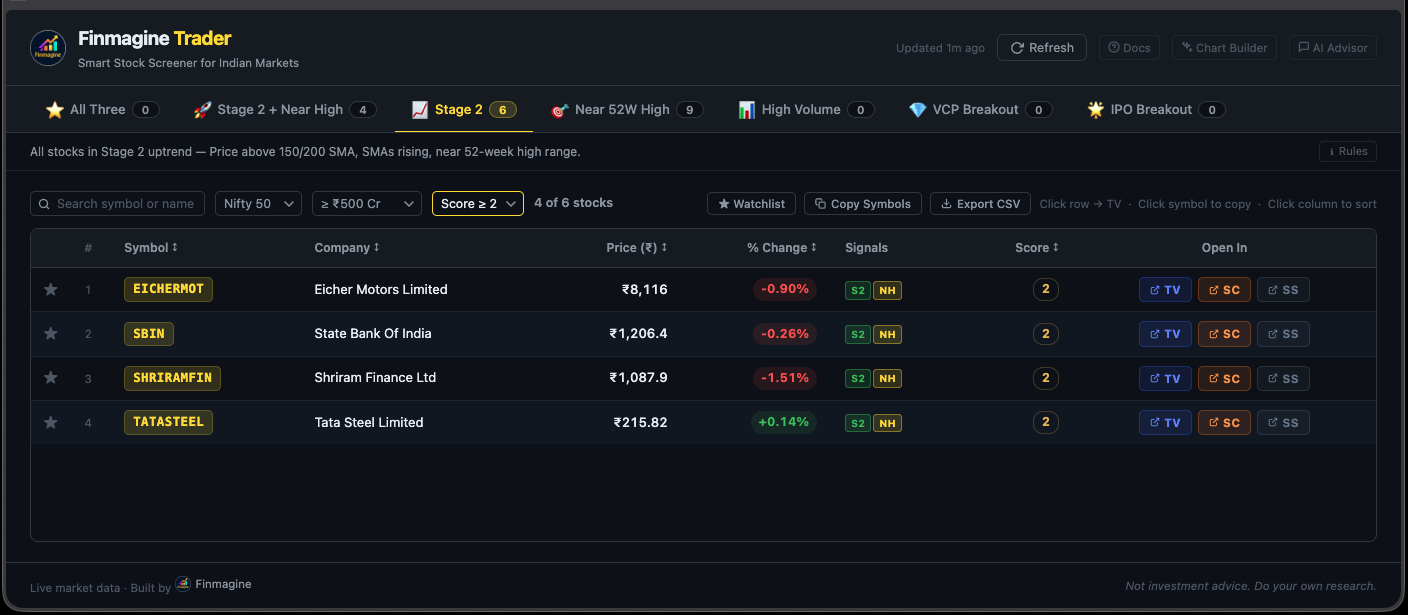
All three filters active — Index (Nifty 500), MCap (≥₹5,000 Cr), Score (≥2). Three orthogonal dimensions applied simultaneously. This is the precision stack.
⚙ Stacking the Filters: Four Recommended Combinations
Because Index, MCap, and Score filters operate on completely different dimensions, they can be mixed and matched freely. The following combinations are practical starting points for different trading styles.
| Combination | Tab | Index | MCap | Score | Typical Result |
|---|---|---|---|---|---|
| Quality Momentum | Stage 2 | Nifty 500 | ≥₹5,000 Cr | ≥2 | 8–20 quality mid/large-cap Stage 2 stocks with secondary confirmation |
| Maximum Conviction | All Three | All | ≥₹500 Cr | =4 | 0–5 stocks where all four frameworks simultaneously agree |
| Small-Cap VCP | VCP Breakout | All | All | ≥2 | VCP candidates with at least one additional signal — a positional trade shortlist |
| Large-Cap Breakout | Near 52W High | Nifty 100 | ≥₹25,000 Cr | ≥1 | Large-cap stocks pressing 52-week highs — institutional-grade breakout candidates |
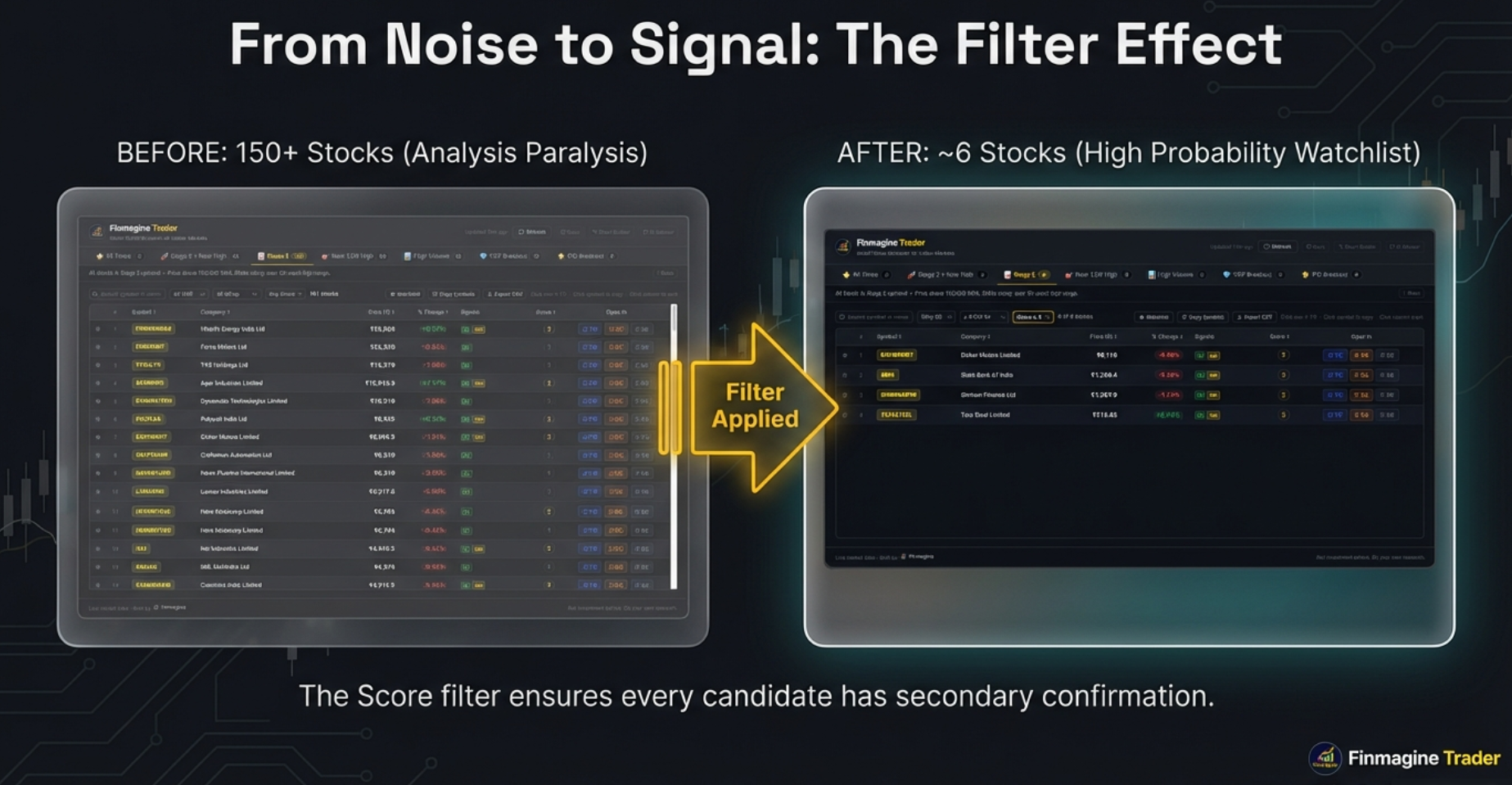
The filter effect in practice. Left: 150+ Stage 2 candidates — analysis paralysis. Right: ~6 stocks after the precision stack is applied. The Score filter ensures every remaining candidate has secondary confirmation beyond just being in an uptrend. This is the difference between “stocks that pass a screen” and “stocks that fit your strategy today.”
Four Trader Archetypes — Which One Are You?
The four combinations above map to four distinct trading personalities. Understanding your archetype sets your default filter configuration each morning.
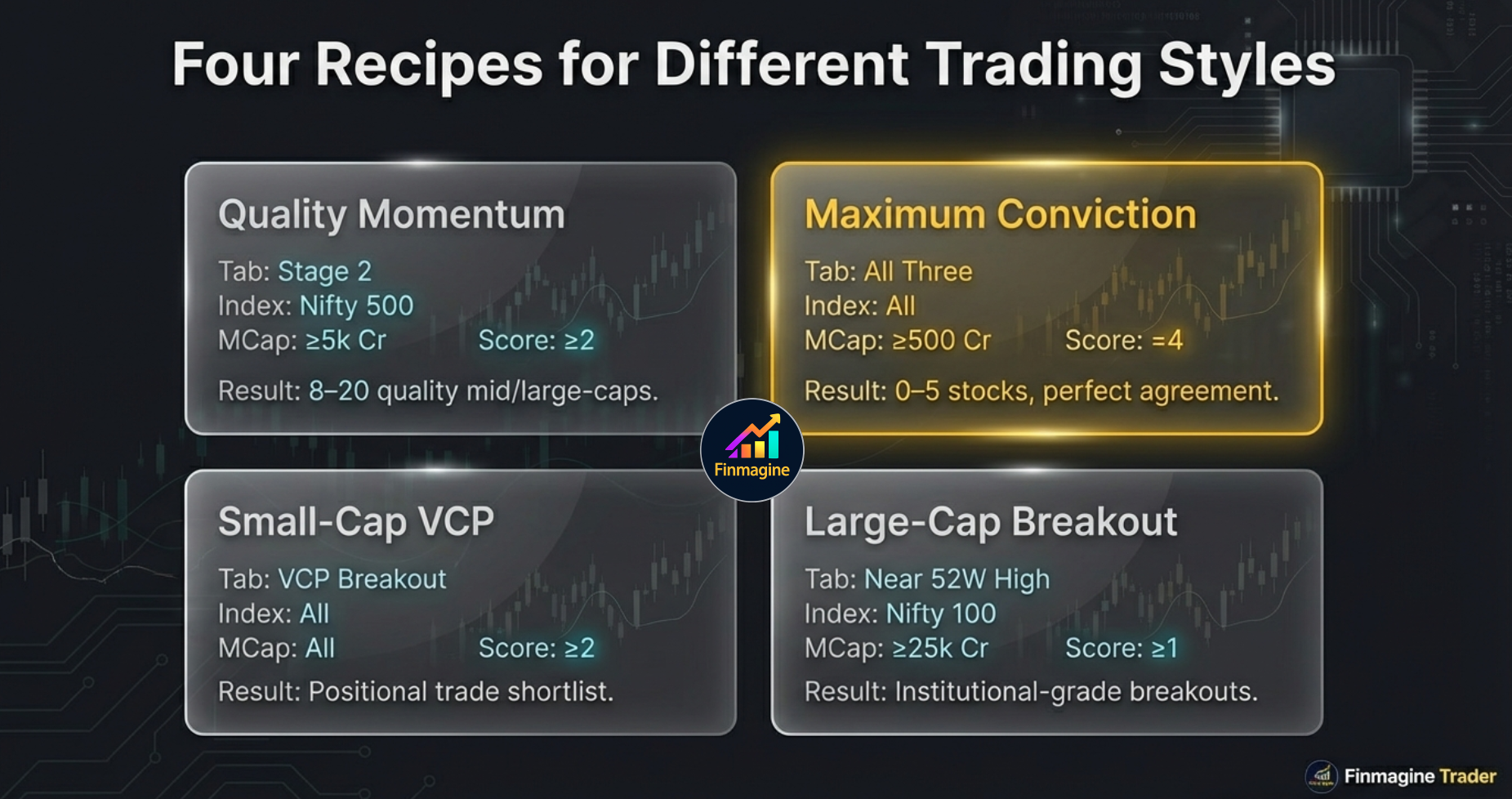
Four filter recipes mapped to four distinct trading strategies. Notice that Maximum Conviction uses “All” for the index rather than Nifty 500 — because a sniper doesn’t want to artificially restrict the universe when hunting the single best setup of the day. The Small-Cap VCP recipe removes both index and MCap restrictions entirely, letting the VCP scan’s own logic do the heavy lifting.
Quality Momentum Trader
Wants solid mid-to-large-caps in a confirmed uptrend with secondary confirmation. Needs a manageable list that can be reviewed quickly before market open.
Result: 8–20 quality names
The Sniper
Only wants the absolute best setup of the day. Zero to five names, maximum confluence. Prefers to pass on a mediocre day entirely rather than trade a second-best setup.
Result: 0–5 stocks
Small-Cap VCP Hunter
Hunts explosive positional moves in stocks forming tight compression patterns. Comfortable with small-cap liquidity risk in exchange for higher reward potential.
Result: VCP positional shortlist
Institutional-Grade Breakout Trader
Trades large-caps pressing their 52-week highs. Wants breakouts where institutional money is forced to chase — lowest risk, tightest spreads, highest liquidity.
Result: Large-cap breakout list
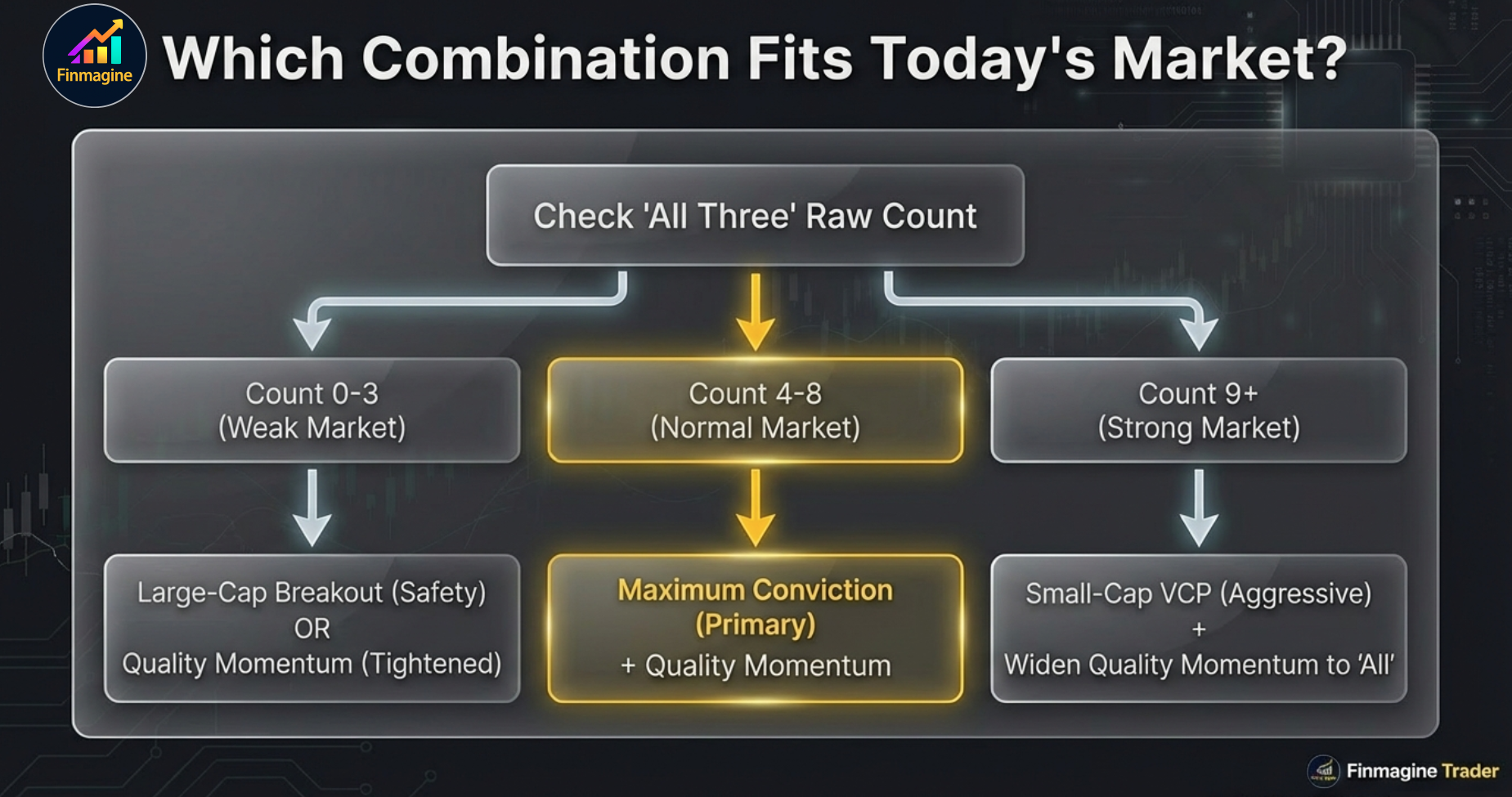
Choosing your combination based on today’s market. The unfiltered All Three count is your morning health check. A low count (0–3) means broad momentum is weak — defensive plays only. A normal count (4–8) is the standard operating environment. A high count (9+) signals broad strength — you can afford to widen the universe and look for more aggressive setups. Let the market tell you which archetype to run today.
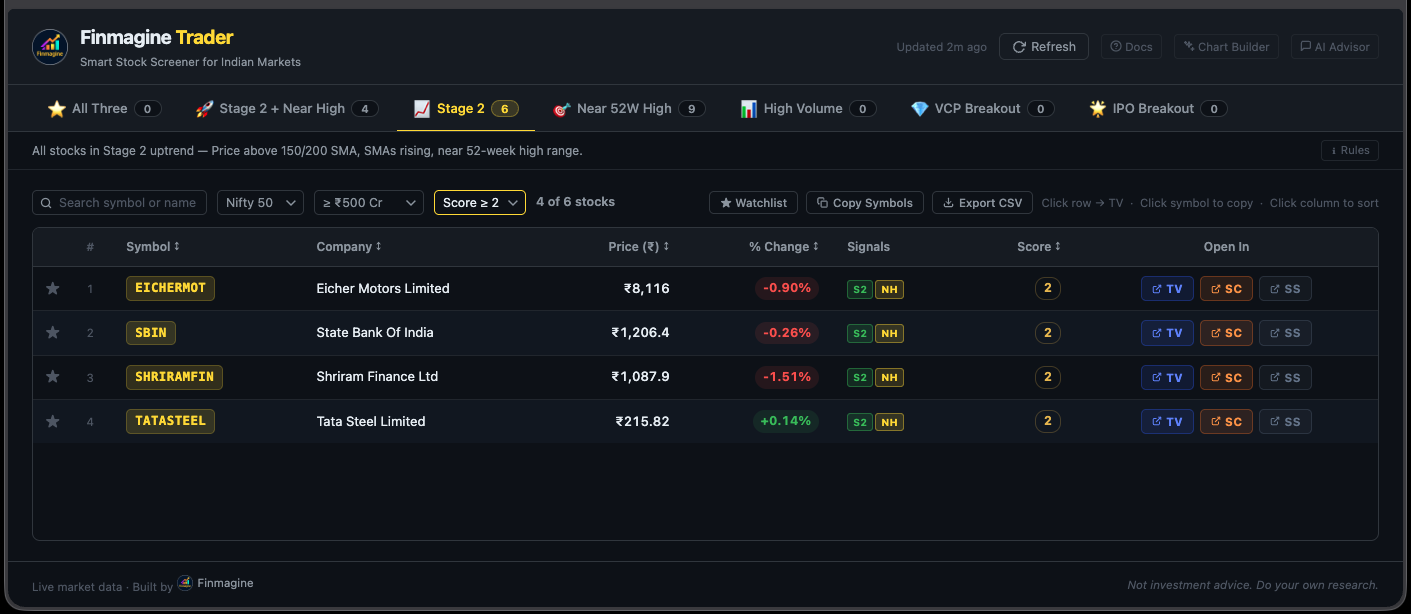
The end state — All Three tab with precision filters applied. From 161 Stage 2 candidates to a focused, high-conviction shortlist ready for chart analysis.
☼ The 5-Minute Morning Workflow
Here is how to use all three filters together in a structured morning routine — from extension open to trade-ready shortlist in under 5 minutes.
Read the raw All Three count
Open the extension. The unfiltered All Three count is your daily market health indicator. 0–3: cautious. 4–8: normal. 9+: broad strength. This tells you how aggressively to filter today.
Set Index Filter: Nifty 500
Apply this one step immediately. It eliminates thinly traded micro-caps from every tab simultaneously, without changing a single scan parameter.
All Three tab — Score = 4
Any stocks here (Nifty 500, all four signals firing) are your primary candidates for the day. Write them down immediately.
Stage 2 tab — Score ≥ 3
Still with Nifty 500 active, switch to Stage 2 and apply Score ≥ 3. This gives the broader quality momentum list — typically 10–25 names. Add new ones not already on your list.
Adjust MCap — check VCP
If you trade small-caps, clear the MCap filter and check VCP with Score ≥ 2. If you trade mid/large-caps, the Nifty 500 + MCap ≥ ₹5,000 Cr combination has already done the work.
Export — open TradingView
Copy Symbols to paste into a TradingView watchlist, or Export CSV for offline analysis. The extension’s job is done. Your job is chart analysis, not scanning.
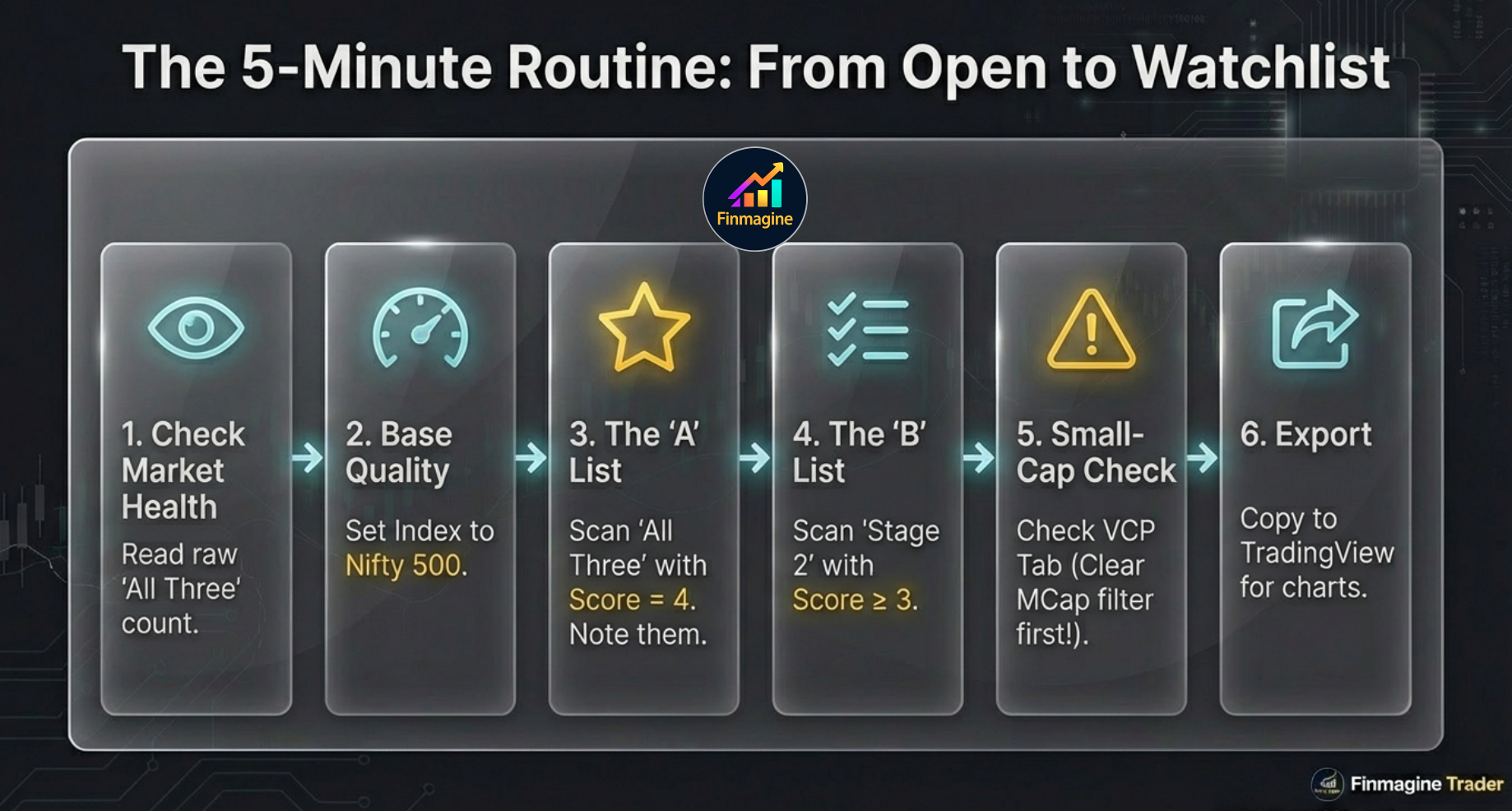
The complete 6-step morning routine in one visual. Step 1: check raw All Three count (market health). Step 2: set Index to Nifty 500 (quality baseline). Step 3: scan All Three with Score =4 (primary candidates). Step 4: scan Stage 2 with Score ≥3 (secondary list). Step 5: check VCP tab if trading small-caps. Step 6: export symbols to TradingView. Total time under 5 minutes with practice — and then your real work, chart analysis, begins.
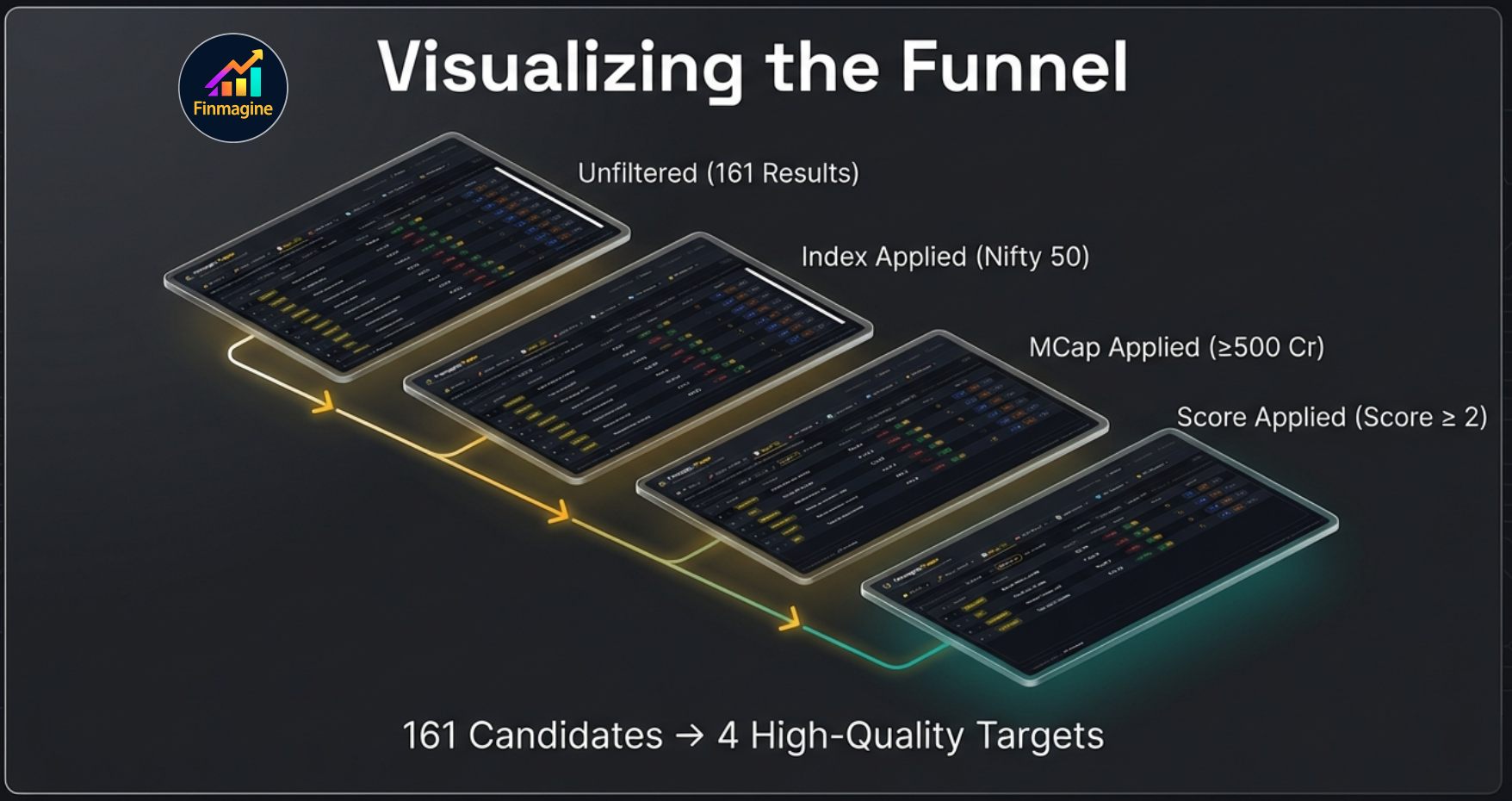
The complete stacking journey visualised. Four screens, four stages: 161 unfiltered results → Index applied (Nifty 50 shown) → MCap applied (≥₹500 Cr) → Score applied (≥2). At each stage, names that don’t meet the current dimension’s requirement fall away. What remains is not just a shorter list — it is a fundamentally different quality of list: every name has passed independent checks on quality, size, and conviction simultaneously.
Stop scanning. Start analyzing. The extension’s job ends the moment you export your shortlist. Your job — chart analysis, entry planning, risk definition — begins right there. The precision filters exist so you spend your limited pre-market minutes where they actually matter.
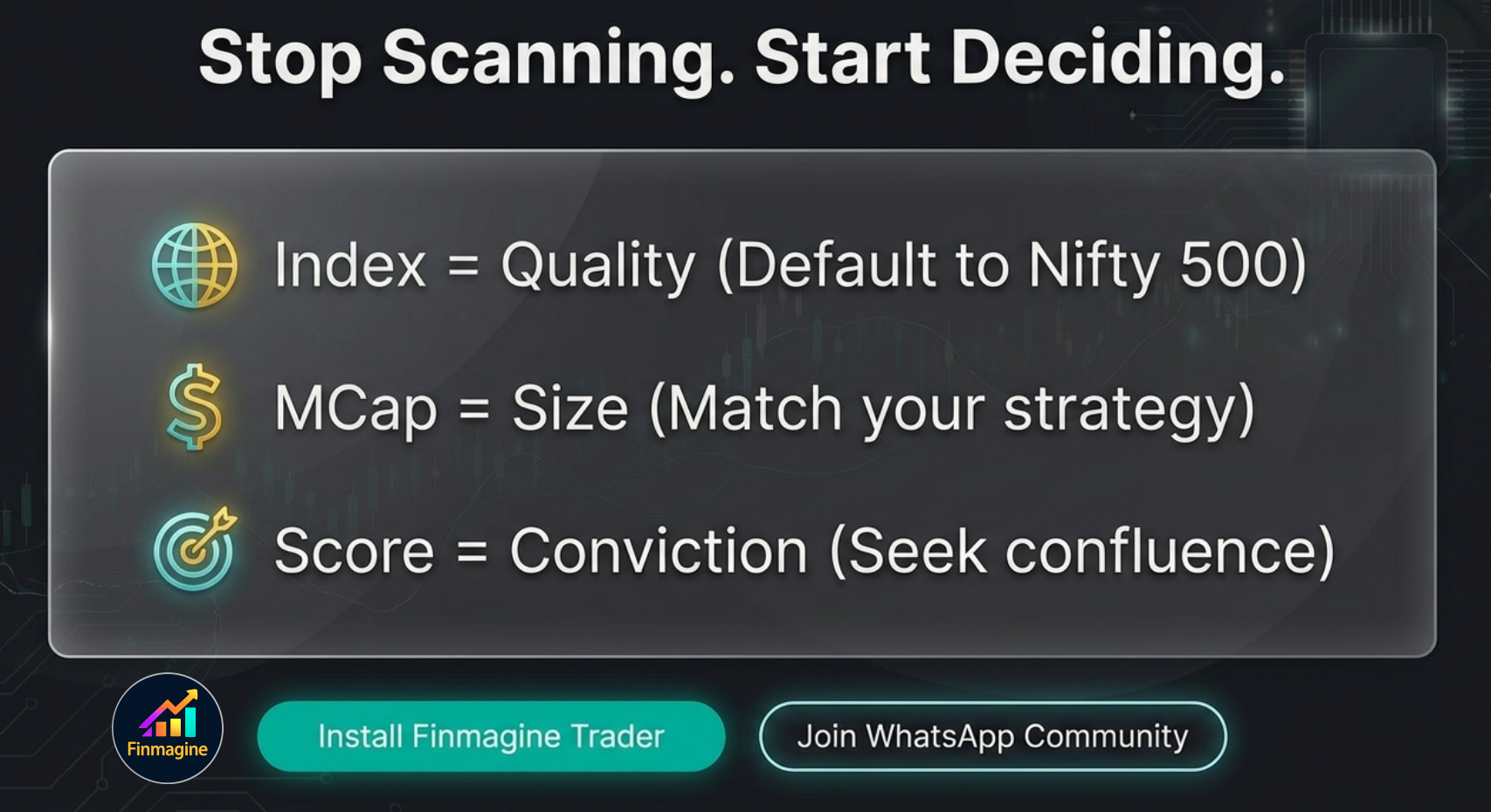
The three-filter framework in one line: Index = Quality. MCap = Size. Score = Conviction. These three orthogonal dimensions are the entire system. Set your defaults, run the 5-minute routine, and move your attention to the charts — where your edge as a trader actually lives.
🔴 v1.4.0 Update — A Fourth Filter: Tight Volatility
Finmagine Trader v1.4.0 adds a fourth precision filter: Tight Volatility — ATR(14) < ATR(50). This applies to the Near 52W High scan and propagates to Stage 2+Near High and All Three via set intersection. When enabled, only stocks where short-term volatility is contracting (the “coiling before breakout” pattern) are shown. Off by default. Unlike the three filters in this article (which are orthogonal), Tight Volatility works upstream — it narrows the Near High result set before the intersection engine runs. See Article 8: Tight Volatility for the full deep-dive.
Free Chrome Extension
Ready to scan your first momentum list?
Install Finmagine Trader and scan 2,000+ NSE stocks for Stage 2 uptrends, VCP breakouts, near 52-week highs, and volume surges — in one click.
Install from Chrome Web Store →No account required • Works on Chrome, Edge, Brave • NSE stocks only
📚 Continue the Tutorial Series
All articles in the Finmagine Trader series:
Art.1: Introduction Art.2: All Three Signal Art.3: Stage 2 Stocks Art.4: VCP Breakout Art.5: TradingView Watchlist Art.6: IPO Breakout Art.8: Tight Volatility 🔴