Forensic Analysis — US Stock Deep Dive
7-part quantitative framework: Z-Score, F-Score, ROIC-WACC, analyst forensics, forward estimates. Amazon case study. 57 flashcards. Video + Audio.
💡 Does this work if I just paste the prompt into any AI — ChatGPT, Gemini, Claude, Grok?
Yes — works right now, no changes needed.
The prompt is structured text (~1,800 words) containing all the financial data, computed metrics
(health score, CAGRs, DuPont), and analytical instructions. Any capable AI can process it.
For the full Finmagine Five-Parameter scoring structure, use one of the four pre-configured destinations below (Custom GPT, Gemini Gem, Perplexity Space, or Claude Project) — all have the methodology pre-loaded. Pasting into any other LLM works too; you'll just get the model's own analytical framing instead of the structured scoring.
🤖 Finmagine Custom GPT (ChatGPT)
Open Custom GPT →If BSE / NSE / ICRA PDFs aren't loading:
✨ Finmagine Extension Analyst Gem (Gemini)
Open Gemini Gem →
Uses Google's native Deep Research — reads BSE, NSE, ICRA & CRISIL
PDFs natively. Best choice for Deep Research (Template 5) and Management Quality templates.
Requires Gemini Advanced — free for Jio subscribers for 18 months.
🔍 Finmagine Extension Analyst Space (Perplexity)
Open Perplexity Space →
Enriched with live web search — Perplexity fetches real-time news,
recent filings, and current analyst commentary alongside your prompt data.
Best for time-sensitive analysis and Quarterly Review template.
🟠 Finmagine Extension Analyst Project (Claude)
Open Claude Project →
Pre-loaded with Finmagine's Five-Parameter methodology and analysis knowledge base — same structured scoring as the Custom GPT. Uses Claude Sonnet with a 200K context window, ideal for large deep-research prompts.
Requires Claude.ai Pro account. Best choice if you already use Claude as your primary AI.
Prompts work with any AI — the four destinations above have Finmagine's Five-Parameter methodology pre-loaded for structured scoring. Any other model (Grok, Llama, etc.) works too with its own framing.
Institutional-Grade Stock Analysis — India & US/Global
Free Chrome extension for Indian stocks (Screener.in) and US/Global stocks (stockanalysis.com). 16 analysis templates — including the new Business KPIs Deep Dive for operational intelligence, Sector & Theme Analysis, Investor Panel, Forensic Governance, Peer Comparison, and the featured Forensic Analysis (Z-Score, F-Score, ROIC-WACC). Sector-aware intelligence across 18 Indian sectors and 145 GICS industries. All running privately in your browser.
Download Free Extension View Deep DiveSee it in action
7-part quantitative framework: Z-Score, F-Score, ROIC-WACC, analyst forensics, forward estimates. Amazon case study. 57 flashcards. Video + Audio.
stockanalysis.com support, Altman Z-Score, Piotroski F-Score, ROIC-WACC, 145 GICS industries, 50 flashcards
Architecture, 7 templates incl. Forensic Governance & Peer Comparison, sector-aware intelligence, unit economics, and 72 flashcards
5-analyst quantified integrity audit. RPTs as % of revenue, pledging trends, earnings call evasion detection. 20 flashcards.
Auto-detects 8 peers, fetches live metrics, 4-analyst scorecard. TCS case study. 18 flashcards.
Know what data your AI prompt contains before sending. Live NSE momentum scan signals from Finmagine Trader appear inline on every Screener.in page. 15 flashcards.
Jhunjhunwala, Pabrai, Mukherjea, Andrade, Maheshwari & Graham independently debate any Indian stock. Each gives a structured verdict with numbers. Full Uno Minda case study. 25 flashcards.
NotebookLM-style Q&A for Indian stocks — type any question, Claude reads all concalls and annual reports, answers with exact citations. Plus manual peer selection to fix wrong GICS groupings. Innova Captab case study. 22 flashcards.
11-part institutional macro-thematic brief with three mandatory structured outputs: Porter’s Five Forces scored 1–10 (Indian context), Global Peer Porter Ranking, MOAT verdict + 2×2 Investment Implication Matrix. Plus TAM, policy dependency rating, tailwinds & headwinds, historical cycle, global analogues, bear case scenarios. Best with Gemini Deep Research. KEI Industries case study.
8-part institutional framework: Financial Health (Z-Score, F-Score), Growth Quality, Competitive Positioning, Unit Economics, Management Quality, Valuation percentile, Risk-Reward scenarios, Five-Parameter Score. Polycab India case study.
7-part operational intelligence framework: KPI table, growth trajectory, quality vs quantity, management execution, red flags, hidden strengths, peer benchmarking + Five-Parameter Score. Case studies: Affle, Titan, DMart. 32 flashcards.
Introduction to all 3 mutual fund templates on Value Research Online — Deep Analysis, Active vs Index, Portfolio Fit — with a decision tree. Start here if you're new to MF analysis with AI.
7-dimension mutual fund audit: consistency, risk-adjusted returns, alpha decay, benchmark integrity, downside protection, manager behaviour, forward viability. PPFAS Flexi Cap case study. 12 flashcards.
What Suitable / Conditionally Suitable / Not Suitable means in practice, how to interpret conditions, dimension weights, and when to override the verdict.
Does your fund earn its expense ratio? Net alpha after fees, TRI vs PRI benchmark trap, 4 analyses, Choose Active or Choose Index verdict. HDFC Mid-Cap worked example.
The 5 elements of a strong context paragraph, weak vs strong examples with AI output quality comparison, reusable template you can write in under 5 minutes.
Complete end-to-end Portfolio Fit worked example: 3-fund portfolio, candidate fund evaluation, 5 AI dimensions, Hold verdict + sensitivity analysis. Full 3-template due diligence workflow. 11 flashcards.
Category Scoring (Revenue / Margin / Capex / Strategic) + 4 named archetypes: Conservative Promiser, Reliable Executor, Optimistic Narrator, Erratic — with investment implications. 15 flashcards.
🔵 VISIBLE / 🟡 GUIDED / 🟢 OPTIONALITY tags on every catalyst + Trigger Scoreboard (Dominant Theme, Trigger Density, Re-Rating Probability). 15 flashcards.
5-section structural intelligence: chain map, pricing power chokepoints, vertical integration trajectory, 10-year disruption exposure, Chain Verdict. Best with Claude · Perplexity. 15 flashcards.
Forensic DRHP/RHP analysis: Business Reality Check, Financial Forensics, Promoter Audit, Use of Proceeds, Valuation Sanity Check, Risk Factor Triage. COMPELLING / WATCHLIST / APPROACH WITH CAUTION verdict. 15 flashcards.
Forensic Annual Report scan for any listed Indian company. 7 sections, N/18 red flag scorecard. 🟢 CLEAN / 🟡 WATCH / 🔴 CAUTION overall rating. Most critical finding + one concall question. 15 flashcards.
Zero data collection guarantee and architecture details
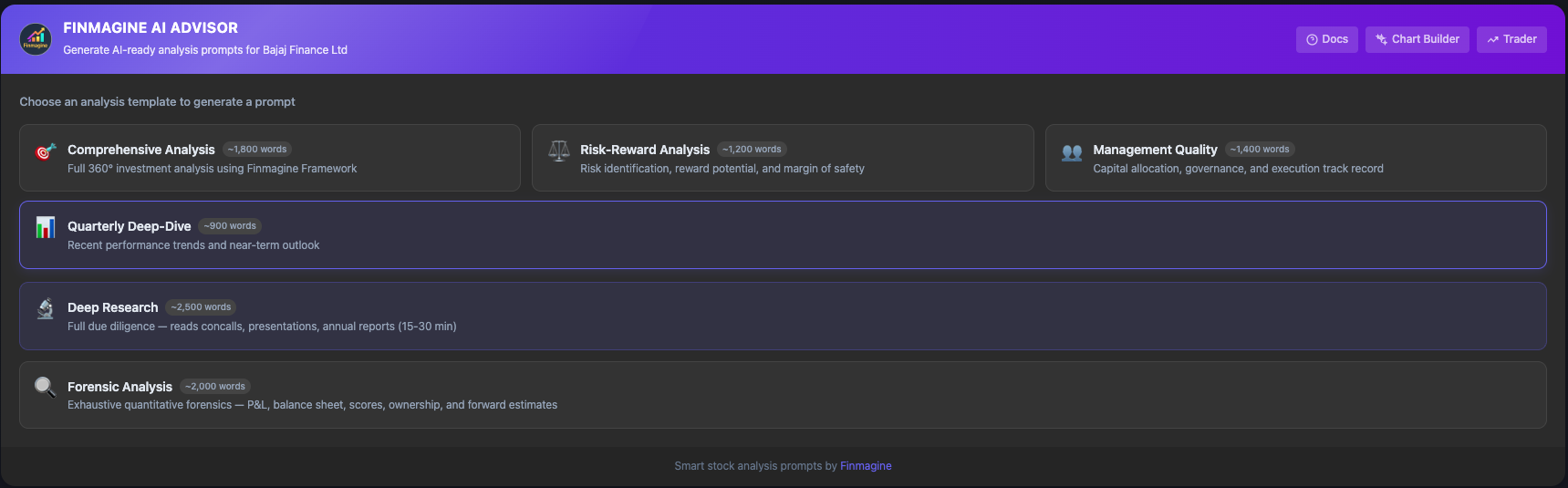
This is what you'll see when you install the extension and visit any Screener.in company page:
The AI Advisor panel appears automatically below the chart section on every Screener.in company page — nine analysis templates ready to generate institutional-grade research prompts
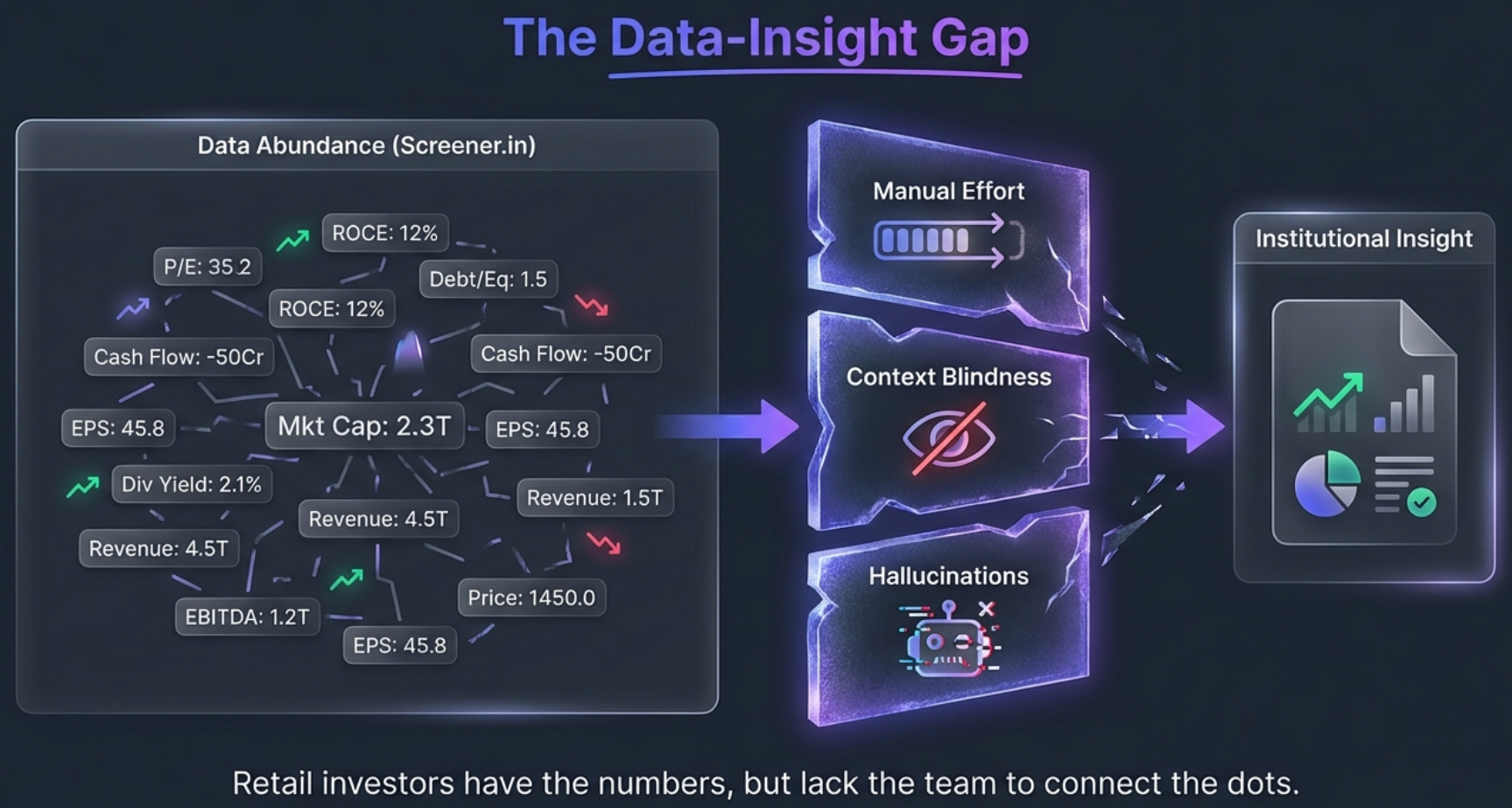
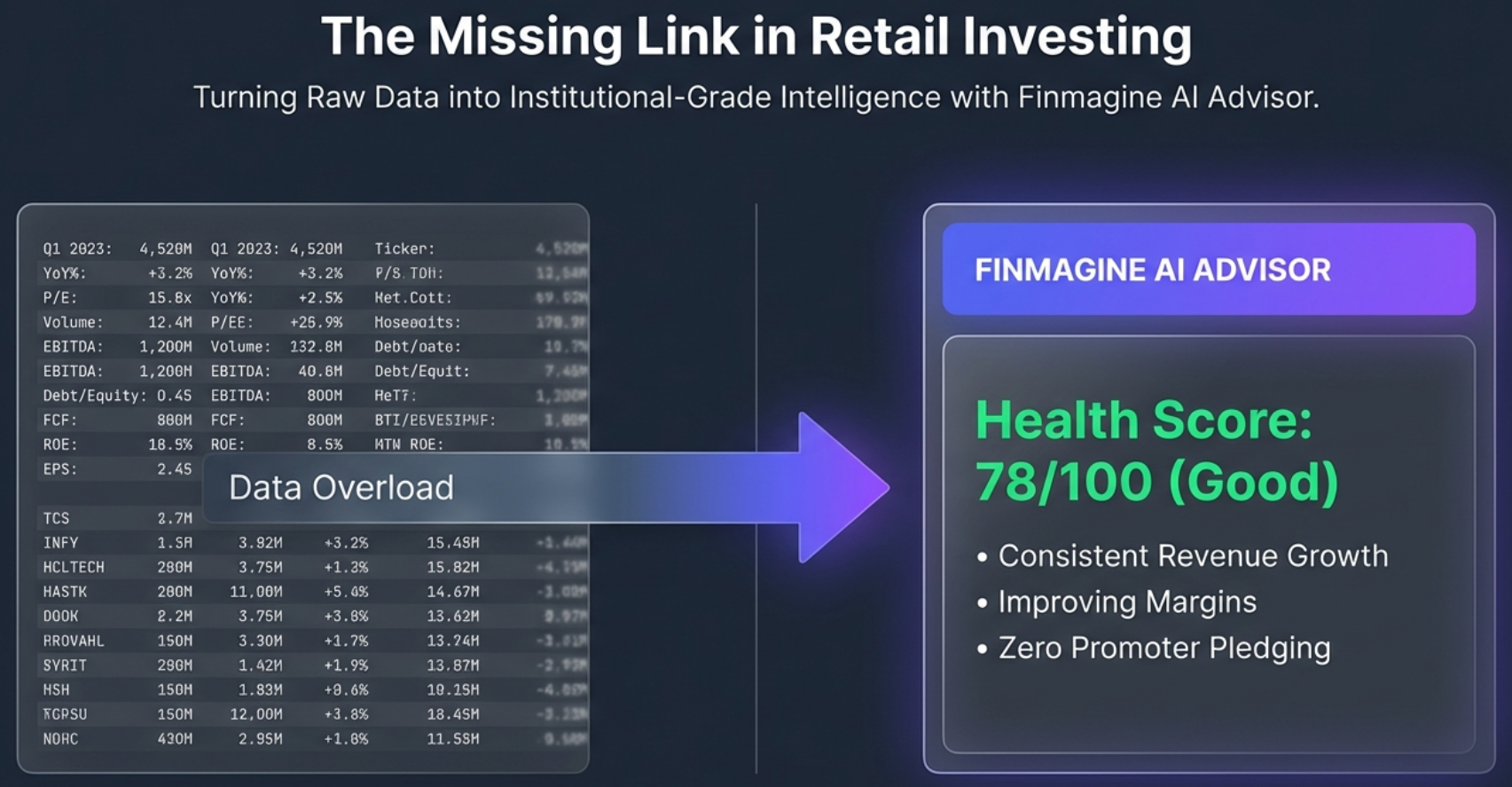
Screener.in gives you the data. But turning 12 years of financial tables into a coherent investment thesis still requires the kind of structured analytical thinking that institutions have systematized. The AI Advisor bridges this gap — extracting everything on the page, running sector-aware analysis, and generating research prompts that a Custom GPT transforms into institutional-grade output.
18 industry profiles with customized thresholds. Banks use P/B, not P/E. Metals use EV/EBITDA. Negative cash flow is normal for lending. The extension knows the difference.
Health Score (0-100), CAGR calculations at 4 horizons, DuPont ROE decomposition, valuation verdicts, strengths and concerns — all computed before GPT even gets involved.
The featured template instructs GPT to browse actual BSE PDFs — concall transcripts, annual reports, investor presentations — for 9-part forensic due diligence.
Your research habits, prompts, and AI conversations stay entirely private — never transmitted to any server. Stock fundamentals for pages you visit are passively contributed to Finmagine's shared cache to improve speed for all users.
Key metrics, 6 financial tables, shareholding patterns, document URLs, pros/cons, sector classification — all extracted on page load in milliseconds.
No subscriptions, no trials, no hidden costs. Institutional-grade analysis workflow completely free for every Indian stock investor.
From raw Screener.in data to AI-ready research prompt in seconds:
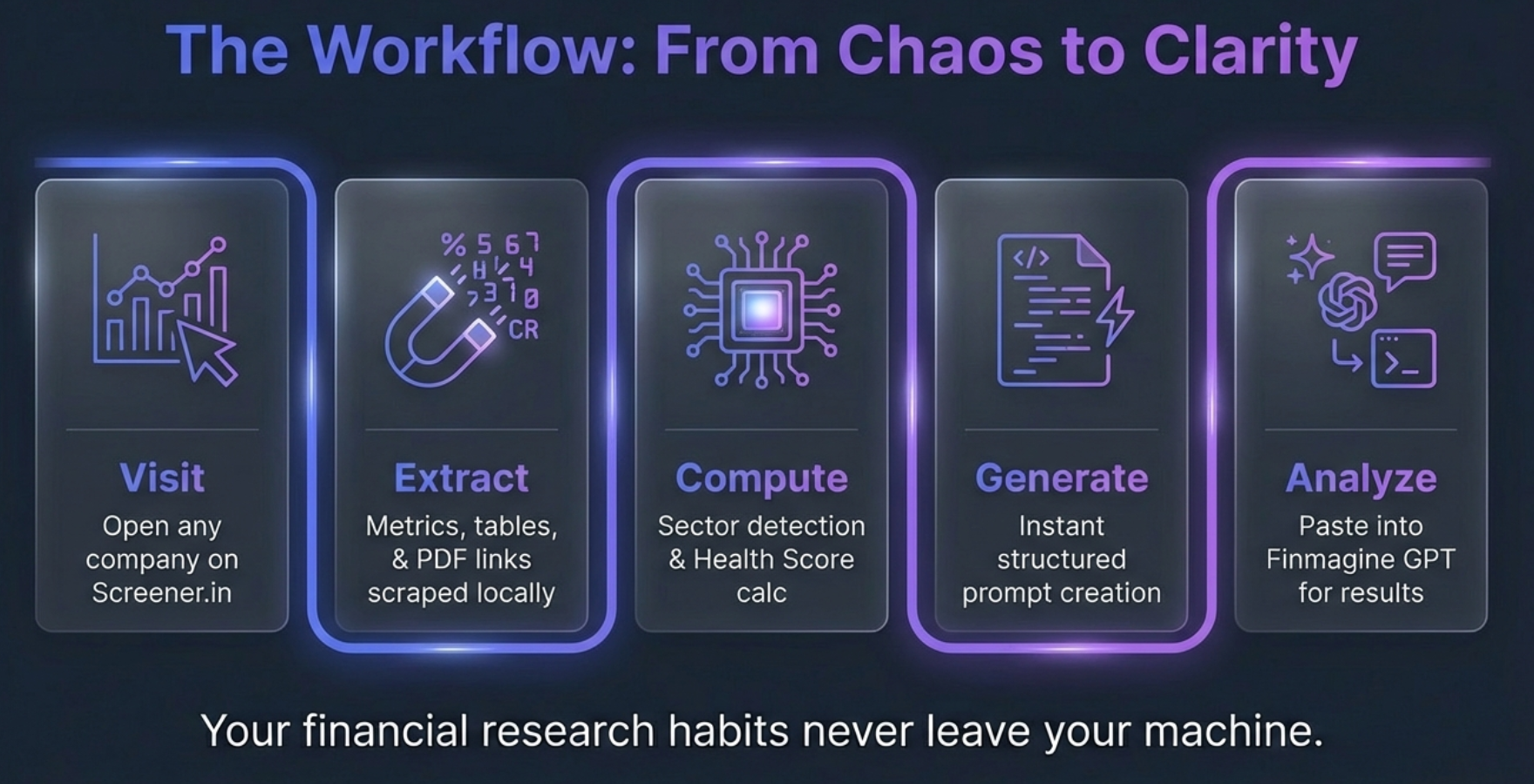
Go to any company on Screener.in (e.g., TCS, HDFC Bank, Polycab). The extension activates automatically and extracts all visible data — key metrics, financial tables, shareholding patterns, document links, pros/cons, and sector classification.
Pick from 5 specialized templates depending on your question. Need a complete thesis? Comprehensive Analysis. Worried about risks? Risk-Reward. Want forensic due diligence? Deep Research. The analysis engine runs on first click, computing health scores, CAGRs, and DuPont decomposition.
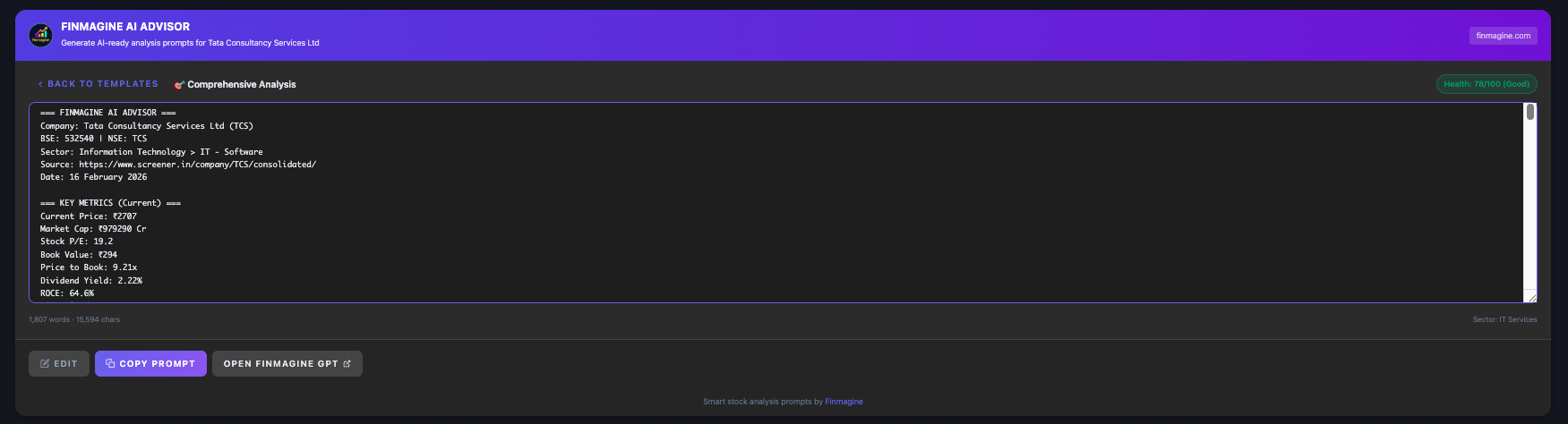
Click "Open Finmagine GPT", "Open Gemini Gem", "Open Perplexity", or "Open Claude" — the prompt is automatically copied to your clipboard and the AI opens in a new tab simultaneously. Just paste and go. You can also edit the prompt before sending, or download it as a .txt file to archive, share, or use with any other AI. All four pre-configured destinations are loaded with Finmagine's Five-Parameter scoring methodology and produce institutional-grade research in minutes.
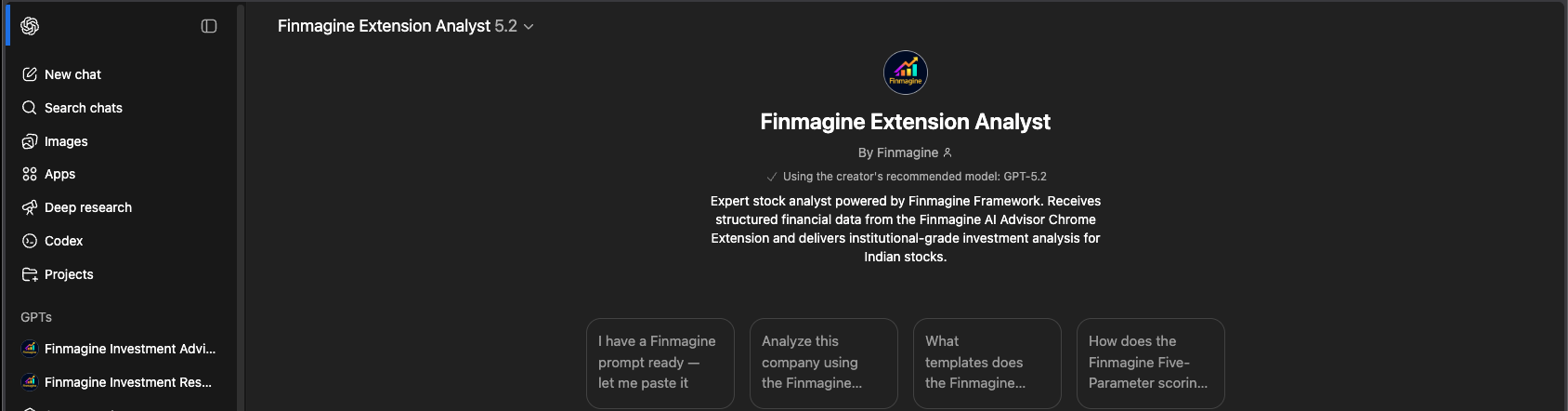
The Finmagine Extension Analyst — a purpose-built Custom GPT running on GPT-5.2 with the Five-Parameter scoring methodology baked into its knowledge base
Prefer Google's Gemini? The Finmagine Extension Analyst Gem is now live — same Five-Parameter methodology, but powered by Gemini's native Deep Research. It browses BSE/NSE filings, concall transcripts, and annual reports in real time (not just the links you paste), and outputs a structured document with a Contents panel and Export to Sheets for the score table. Especially powerful for the Deep Research template. Many Jio subscribers already have Gemini Advanced included in their plan at no extra cost.
Prefer real-time research? The Finmagine Extension Analyst Space enriches your prompt with live web search — Perplexity fetches recent news, current analyst commentary, and the latest filings alongside the structured data the extension extracts. Best for the Quarterly Review template when recency matters most. Available on the free Perplexity tier.
Prefer Claude? The Finmagine Extension Analyst Project runs on Claude Sonnet with a 200K context window — ideal for large deep-research prompts where other models hit limits. Pre-loaded with Finmagine's Five-Parameter methodology and analysis knowledge base. Includes Incremental ROCE analysis to identify true compounders. Best choice if you already use Claude.ai Pro as your primary AI.
Each template is a different lens to examine a company through. Pick the one that matches your current question:
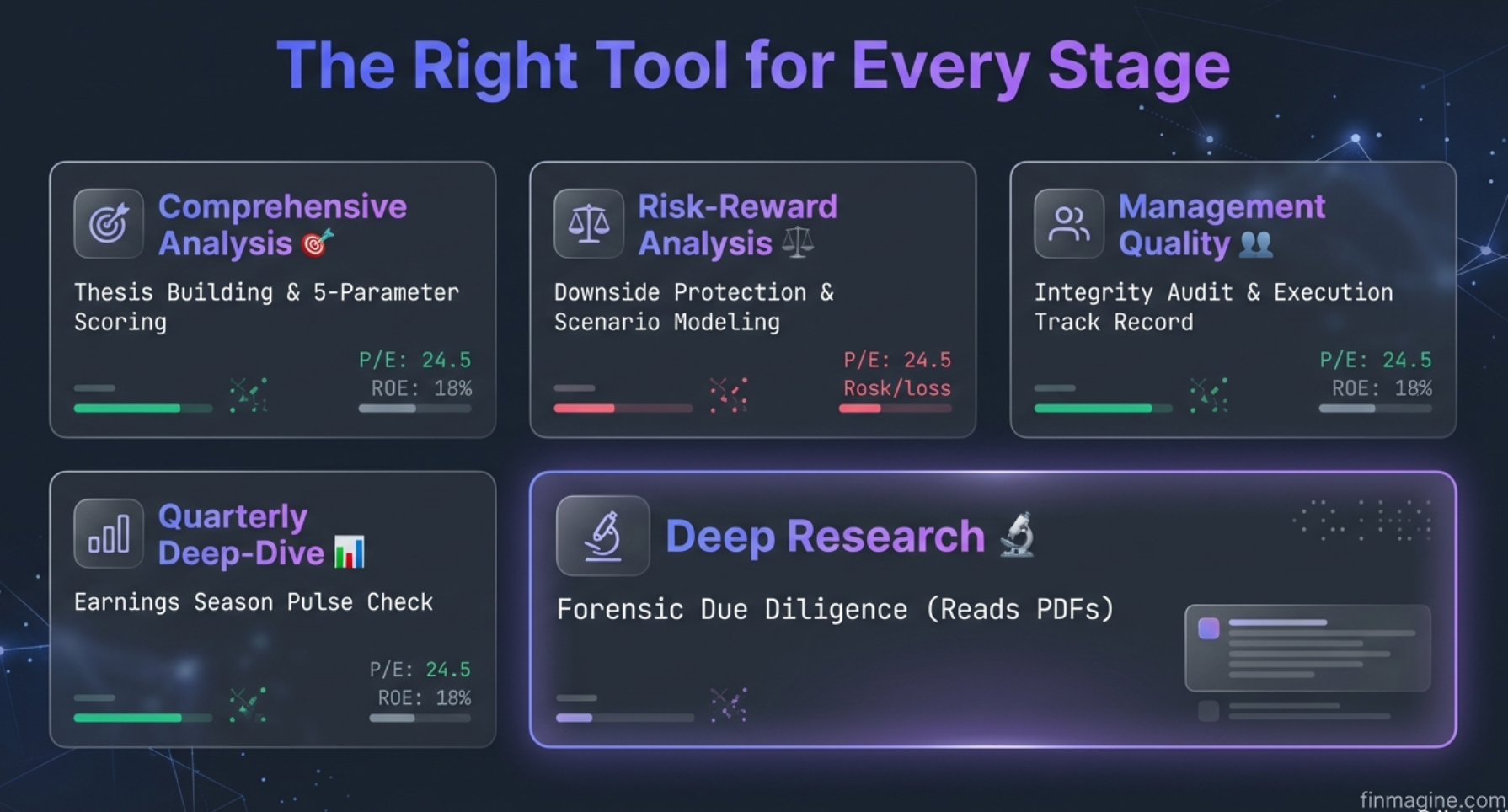
Full 360-degree investment thesis using the Five-Parameter Weighted Scoring Framework. Financial Health, Growth, Competitive Position, Management Quality, and Valuation — each scored 2-10 with a weighted composite. Now includes unit economics (₹/subscriber, ₹/tonne, revenue/employee) reconciled against consolidated financials.
GPT time: 2-3 min | ✦ Best with: Gemini Deep Research
Identify material risks across 5 dimensions and model probability-weighted Bull/Base/Bear return scenarios. Includes "Cheap for a Reason" detection and margin of safety assessment.
GPT time: 2-3 min | ✦ Best with: Claude / ChatGPT
12-quarter Promise vs. Delivery tracking with a Category column (Revenue / Margin / Capex&Project / Strategic) to reveal category-specific credibility patterns. Closes with a named Credibility Pattern archetype: Conservative Promiser, Reliable Executor, Optimistic Narrator, or Erratic — with investment implications. Catches "Metric Shopping" red flags.
GPT time: 3-5 min | ✦ Best with: Gemini Deep Research | Full Tutorial →
Sequential quarterly trend analysis, earnings quality checks, margin trajectory, and forward guidance extraction. Now includes Section 0C Narrative Drift: detects Vanishing Topics, New Talking Points, Metric Retreat, and delivers a Drift Verdict (Suspicious Pivot / Tactical Adjustment / Organic Evolution / None Detected). Answers: Is quarterly momentum supporting or diverging from the annual story?
GPT time: 2-3 min | ✦ Best with: Claude / ChatGPT
The GPT goes beyond the prompt data — it browses and reads actual BSE PDFs including concall transcripts, investor presentations, and annual reports. Produces a 9-part forensic analysis. Growth Triggers upgraded: every trigger now carries a conviction tag (🔵 VISIBLE / 🟡 GUIDED / 🟢 OPTIONALITY) and the section closes with a Trigger Scoreboard — Dominant Theme, Trigger Density, and Re-Rating Probability.
GPT time: 15-30 min | ✦ Best with: Gemini Deep Research | Full Tutorial →
An 8-part comprehensive forensics framework combining quantitative analysis with document reading: (1) Financial Health Assessment — balance sheet strength, cash flow quality, Health Score validation; (2) Growth Analysis — revenue and profit CAGR trends, operating leverage potential; (3) Competitive Positioning — moats, market position, sector context; (4) Unit Economics — per-unit revenue, margins, and 3-year unit-level forecast reconciled against consolidated financials; (5) Management Quality — concall commentary, guidance credibility, capital allocation efficiency; (6) Valuation Assessment — PE, PB, EV/EBITDA multi-metric triangulation; (7) Risk-Reward Summary — key risks and catalysts; (8) Five-Parameter Investment Verdict. Reads concall transcripts, investor presentations, and annual reports. Includes Operational KPI data.
Analysis time: 5-10 min | ✦ Best with: Gemini Deep Research / Claude
Institutional-grade governance forensics for Indian stocks: RPTs quantified as % of revenue, promoter pledging trend, CFO/PAT quality table across 5 years, earnings call language analysis (question avoidance, blame-shifting patterns), CARO remarks, auditor change flags, and board independence score. No free tool does this for Indian stocks.
Analysis time: 10-20 min | ✦ Best with: Gemini / Claude (reads BSE/NSE PDFs natively)
The only free tool that auto-assembles sector peer data for AI analysis. Auto-detects up to 8 sector peers from Screener.in, fetches live P/E, ROCE, ROE, OPM, D/E, and Promoter Holding snapshots, then builds a 4-analyst head-to-head framework with pre-filled scorecard table. Identifies best-in-class, best risk-reward, and structural laggard across the peer group. v2.8.0: Manual peer selection — override Screener's GICS peers with custom NSE codes.
Analysis time: 5-10 min | ✦ Best with: Claude / ChatGPT
A virtual panel of 6 legendary investors — Rakesh Jhunjhunwala, Mohnish Pabrai, Saurabh Mukherjea, Kenneth Andrade, Basant Maheshwari, and Benjamin Graham — independently debate any stock using live extracted data. Each delivers: Verdict (Strong Buy to Strong Sell), Conviction sentence with specific numbers, Biggest concern, Key metric to watch, and a Characteristic quote in their own voice. Panel Synthesis: consensus rating, where the panel agrees, the sharpest disagreement, and the one question every investor would ask management.
Analysis time: 5-10 min | ✦ Best with: Claude / ChatGPT
NotebookLM-style Q&A for Indian stock documents. Type any question — AI reads all 12 concall transcripts, annual reports, and credit rating PDFs and answers in a strict FINDING/Source/Finding format with exact citations. No research reports — only citation-anchored answers to your specific question. One focused question works best. Best with Claude only — Gemini Deep Research always produces full reports regardless of question.
Analysis time: 1-3 min | ✦ Best with: Claude
An 11-part institutional macro-thematic research brief with three mandatory structured outputs produced first: (A) Porter’s Five Forces Table — all five forces scored 1–10 with India-specific drivers (conglomerate entry threat, import dependency, GST formalisation, PSU competition), Composite Score, and STRONG / MODERATE / WEAK industry structure verdict; (B) Global Peer Porter Ranking — 5–6 peers (Indian + international) each scored on the same five forces, sorted by composite; (C) MOAT Deep-Dive — five moat types assessed → WIDE / NARROW / NO MOAT verdict with durability horizon + 2×2 Investment Implication Matrix (Compounding Machine / Survival Tool / Theme Play / Avoid). Then the narrative: industry structure + TAM, policy support with Policy Dependency rated 1–5, tailwinds ×3 + headwinds ×3, historical cycle, global analogues, bear cases, and "Buy the company" vs "Buy the theme" verdict. Unlike every other template, the AI must do live web research — financial data is context only.
Analysis time: 5-10 min | ✦ Best with: Gemini Deep Research | Full Guide →
A 7-part operational intelligence framework that reads the Screener.in Operational Insights table — store counts, CPCU rates, conversion volumes, SSSG, CASA ratios — and converts them into institutional-grade KPI analysis: (1) KPI Table with trend annotations; (2) Growth Trajectory — which KPIs are inflecting vs deteriorating; (3) Quality vs Quantity — growth volume cross-checked against unit economics; (4) Management Execution — Guidance vs Actuals table from concall transcripts; (5) Red Flags — 2–3 KPI combinations signalling hidden P&L risk; (6) Hidden Strengths — 2–3 KPI combinations revealing quality invisible in the income statement; (7) Peer Benchmarking + Five-Parameter Score — operational verdict with investment classification (Growth Compounder / Core Compounder / Turnaround / Avoid). Case studies: Affle, Titan, DMart.
Analysis time: 3-5 min | ✦ Best with: ChatGPT | Full Tutorial →
The upgraded Management Quality Deep-Dive adds a Category column to the Guidance Tracker table (Revenue / Margin / Capex&Project / Strategic) so you can see exactly where management is reliable and where they slip. Section 2 closes with a named Credibility Pattern archetype: Conservative Promiser, Reliable Executor, Optimistic Narrator, or Erratic — each with a specific investment implication and category-specific trust discounting where patterns differ by category.
Analysis time: 3-5 min | ✦ Best with: Gemini Deep Research / Claude | Full Tutorial →
Every growth trigger in the Deep Research template now carries a conviction tag: 🔵 VISIBLE (confirmed from actuals), 🟡 GUIDED (stated by management, not yet in numbers), or 🟢 OPTIONALITY (unpriced possibility not in consensus). Rule #6 enforces that tag and evidence must match. The section closes with a Trigger Scoreboard: Dominant Theme, Trigger Density score, and Re-Rating Probability — reducing the full catalyst picture to a single investment posture.
Analysis time: 15-30 min | ✦ Best with: Gemini Deep Research | Full Tutorial →
A 5-section structural intelligence framework: (1) Company Positioning — where in the chain (Raw Material → Component → Semi-finished → Finished → Distribution → Platform → Service Layer) and what % of final product value the company captures, estimated from margins; (2) Full Chain Map — every node from raw material to end consumer, with margin benchmarks and dominant players at each node; (3) Pricing Power Chokepoints — the 2–3 highest-leverage nodes and whether the company controls, is exposed to, or is bypassed by them; (4) Vertical Integration Trajectory — current moves upstream/downstream, capital cost and margin impact, and the inflection year when integration changes the earnings story; (5) Disruption Exposure — 2–4 credible structural threats over 10 years with probability and timeline, and what early indicators to watch. Closes with a Chain Verdict: Structurally Advantaged / Neutral / Vulnerable.
Analysis time: 10-20 min | ✦ Best with: Claude · Perplexity | Full Tutorial →
Forensic DRHP/RHP analysis for companies approaching or recently completing an IPO. Adversarial by design — the AI finds what an optimistic reading of the prospectus would miss. 7 sections: Business Reality Check (revenue/geographic concentration, moat verdict), Financial Forensics (3-year pre-IPO table with window-dressing flags), Promoter & Management Audit (OFS%, pledging, pre-IPO exits, salary vs PAT), Use of Proceeds (growth vs exit funding breakdown), Valuation Sanity Check (vs named listed peers), Risk Factor Triage (3 company-specific risks, no boilerplate), IPO Verdict. Closes with COMPELLING / WATCHLIST / APPROACH WITH CAUTION. Requires the DRHP/RHP PDF uploaded to Claude — not a URL.
Analysis time: 10-20 min | ✦ Best with: Claude | Full Tutorial →
Forensic Annual Report scan for any listed Indian company. Adversarial by design — not asked to balance negatives with positives. 7 sections: Earnings Quality Scan (other income%, revenue recognition policy, DTA trend, exceptional items, accounting policy changes), Balance Sheet Stress Test (3-year table: receivable days, goodwill, capital advances, loans to subs, contingent liabilities), Cash Flow Integrity (3-year PAT vs CFO table — is PAT growth real?), Related Party Audit (entity names, amounts, CLEAN/CONCERNING per transaction), Auditor Signals (tenure, qualifications, EOM, KAMs), Governance & Promoter Behaviour (pledging, salary vs PAT, subsidiaries, dilution). Closes with Red Flag Scorecard: N/18 flags, overall 🟢 CLEAN / 🟡 WATCH / 🔴 CAUTION, most critical finding, and one sharp question for the next concall. Annual Report link auto-injected from Screener.
Analysis time: 5-10 min | ✦ Best with: Claude | Full Tutorial →
Version 2.14 extends AI Advisor to valueresearchonline.com with 3 mutual fund analysis templates. The panel appears on any VRO fund page — navigate to a fund, open the extension, and choose your template. Unlike stock templates, these work on publicly available fund data on the VRO page with no additional input required for Deep Analysis and Active vs Index. Portfolio Fit requires a brief description of your portfolio and goals.
A 7-dimension SEBI suitability framework for mutual funds: (1) Consistency — quartile rank stability across market cycles; (2) Risk-Adjusted Performance — Sharpe and Sortino ratios vs category; (3) Alpha Decay — whether outperformance narrows as AUM grows; (4) Benchmark Integrity — TRI vs PRI comparison and genuine alpha; (5) Downside Protection — maximum drawdown vs benchmark in bear markets; (6) Manager Behaviour — style drift and mandate adherence; (7) Forward Viability — AUM size vs investable universe constraints. Delivers a single SEBI-style verdict: Suitable / Conditionally Suitable / Not Suitable.
Analysis time: 3-5 min | ✦ Best with: Claude / ChatGPT | Full Tutorial →
Calculates net alpha — the return advantage remaining after the expense ratio is deducted from gross outperformance — and answers one question: does this active fund justify its fee over its index equivalent? Covers: (1) Net alpha calculation (gross alpha minus expense ratio); (2) Consistency of outperformance (not just average, but how often); (3) Bear market behaviour vs index; (4) 10-year compounded expense drag in rupees. Exposes the TRI vs PRI benchmark trap that makes most official comparisons misleading. Verdict: Choose Active or Choose Index.
Analysis time: 3-5 min | ✦ Best with: Claude / ChatGPT | Full Tutorial →
Assesses a fund against your specific portfolio. Requires a brief context box: existing funds with allocations, investment horizon with a target year, risk tolerance with behavioural evidence, financial goal with target corpus, and your decision question. The AI then analyses: (1) Mandate fit; (2) Overlap with existing holdings; (3) Goal-mandate alignment; (4) Position sizing; (5) Alternative recommendations if a better fit exists. Verdict: Proceed / Hold / Replace with a specific next step. How to write the context box →
Analysis time: 5-8 min | ✦ Best with: Claude / ChatGPT | Full Tutorial →
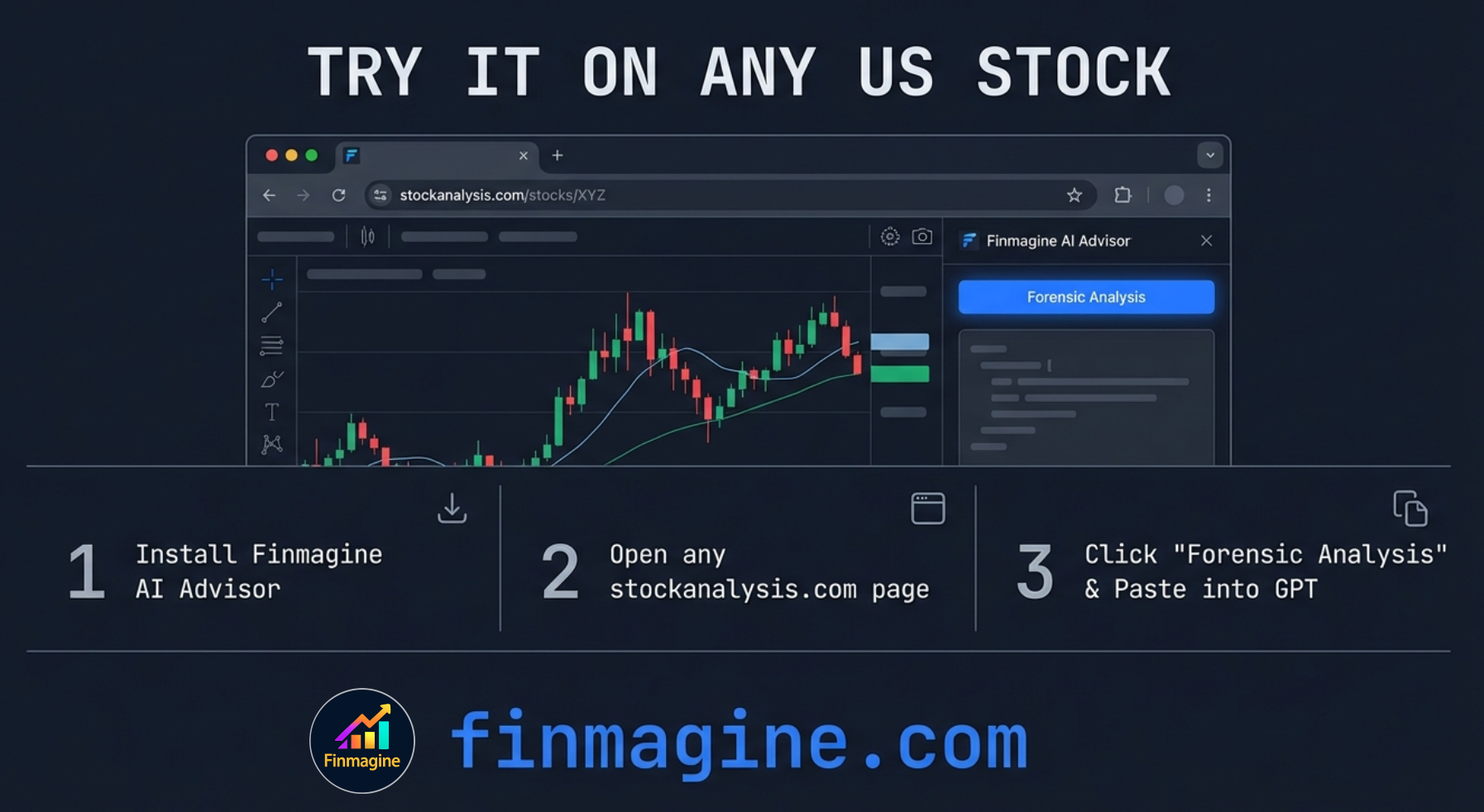
Version 2.0 extends the AI Advisor to stockanalysis.com with 4 US/Global stock templates
— headlined by the featured Forensic Analysis template: a 7-part purely quantitative
investigation that processes 11 pages of financial data per stock, including the exclusive
/forecast/ page for analyst price targets and forward EPS estimates.
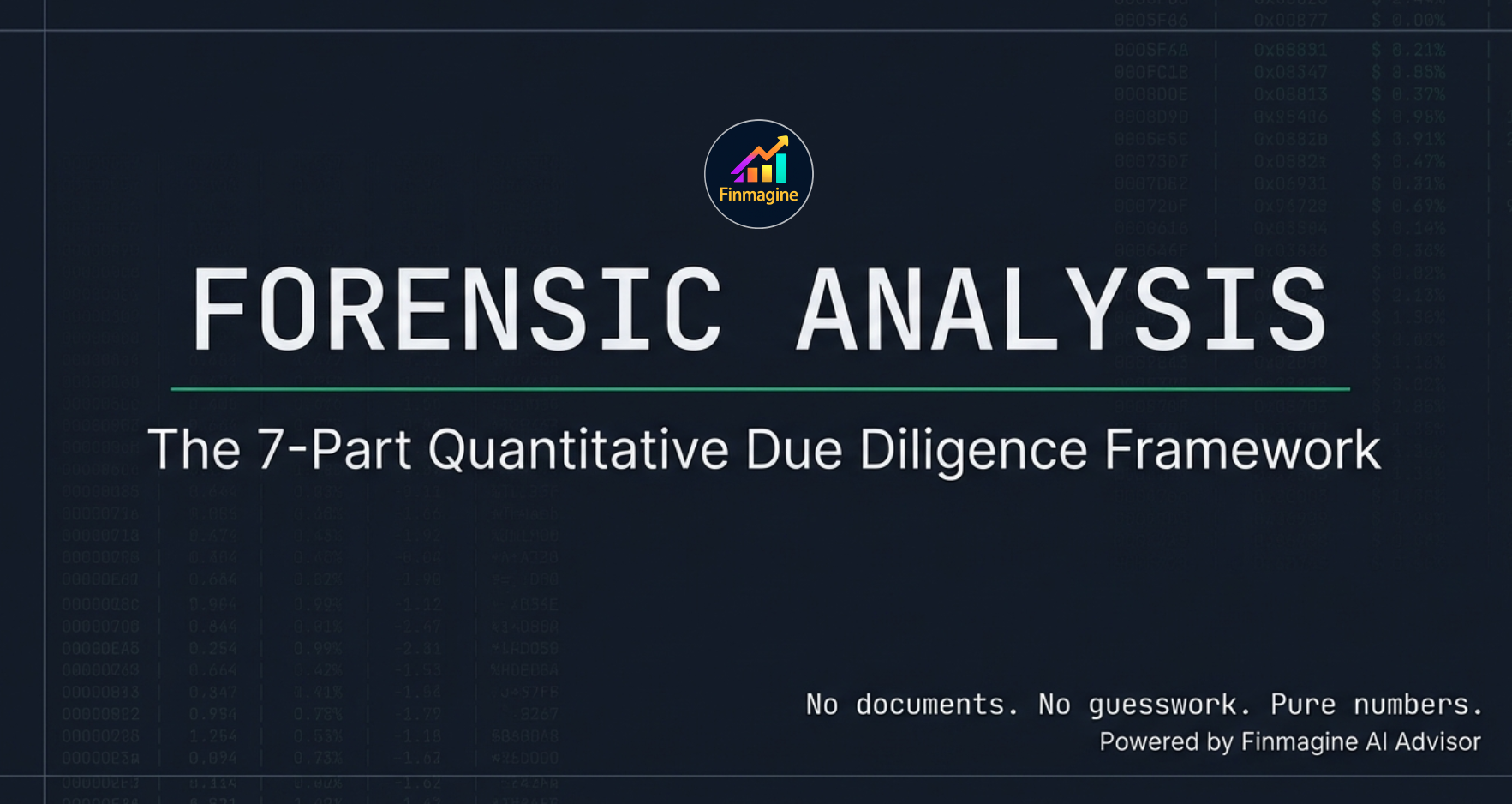
Each US template is a different lens. Forensic Analysis is the deep investigation template — the US equivalent of Deep Research, but purely quantitative (no concall PDFs on stockanalysis.com).
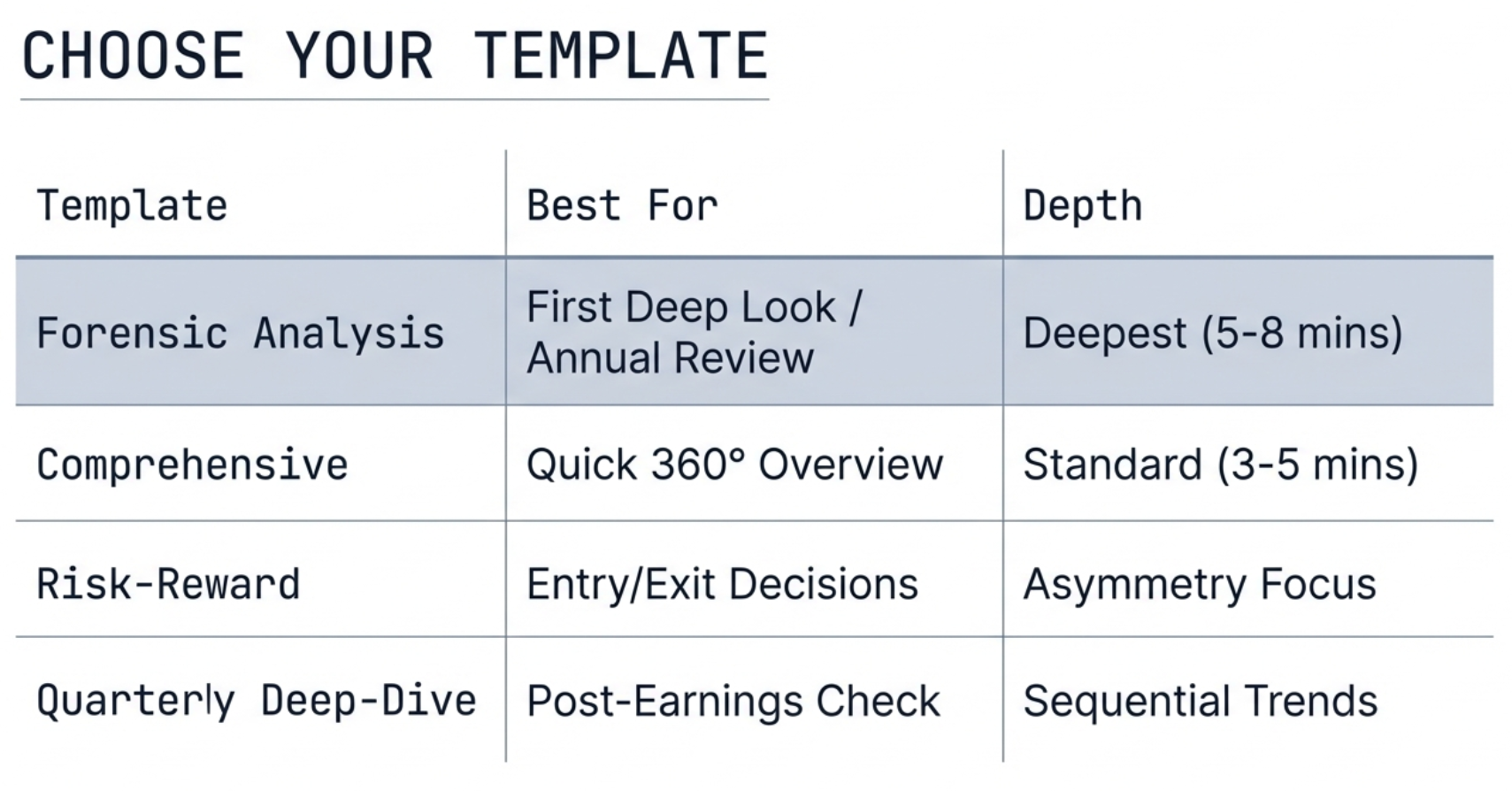
Part 1: Financial Forensics (P&L, Balance Sheet, Cash Flow, Ratios) → Part 2: Financial Health (Altman Z-Score + Piotroski F-Score) → Part 3: Value Creation (ROIC vs WACC) → Part 4: Ownership Intelligence (Institutional, Insider, Short Interest) → Part 5: Analyst Consensus Forensics (price target spread, recommendation trends, forward estimates) → Part 6: Valuation Forensics → Part 7: Final Verdict (Five-Parameter Score + Bull/Base/Bear).
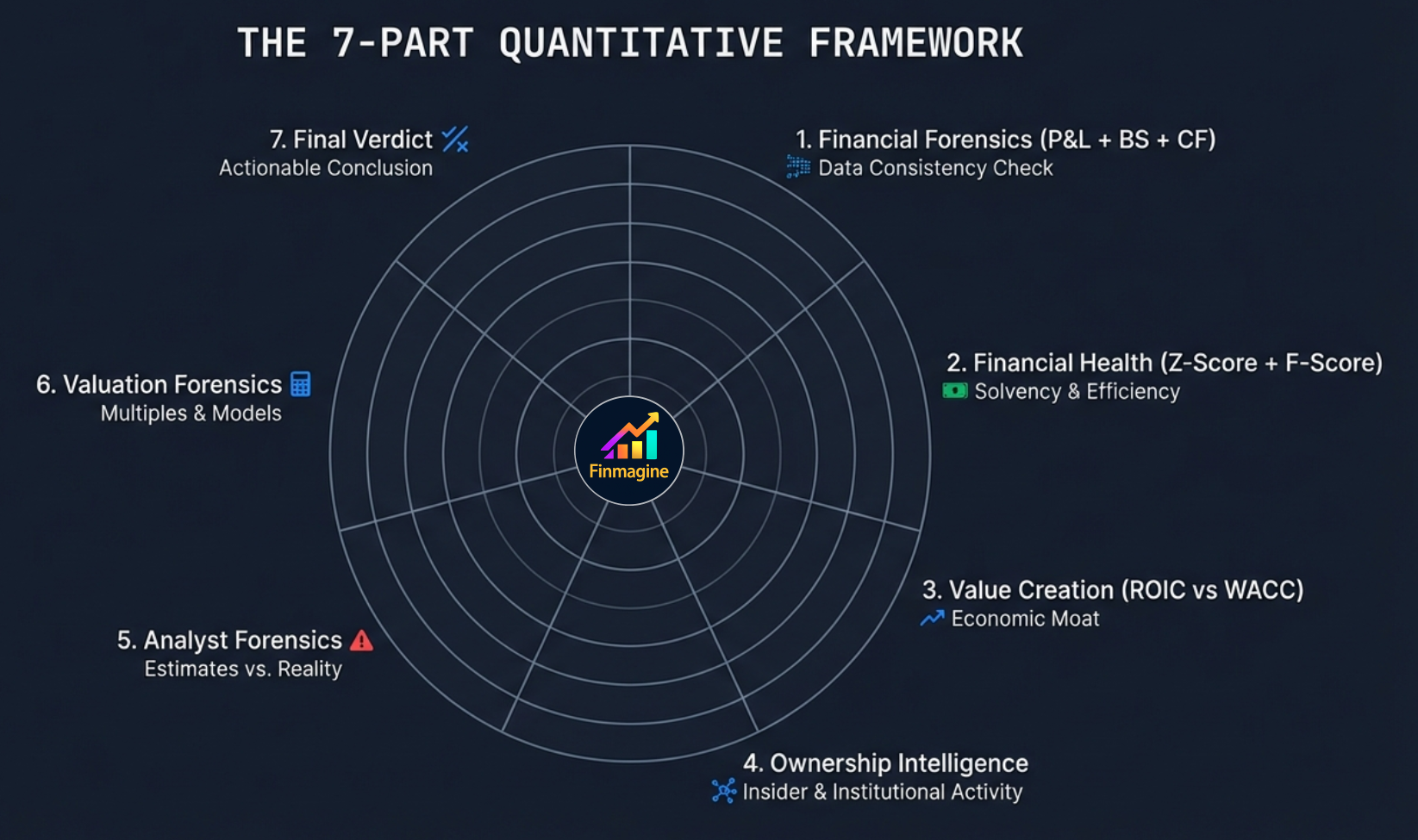
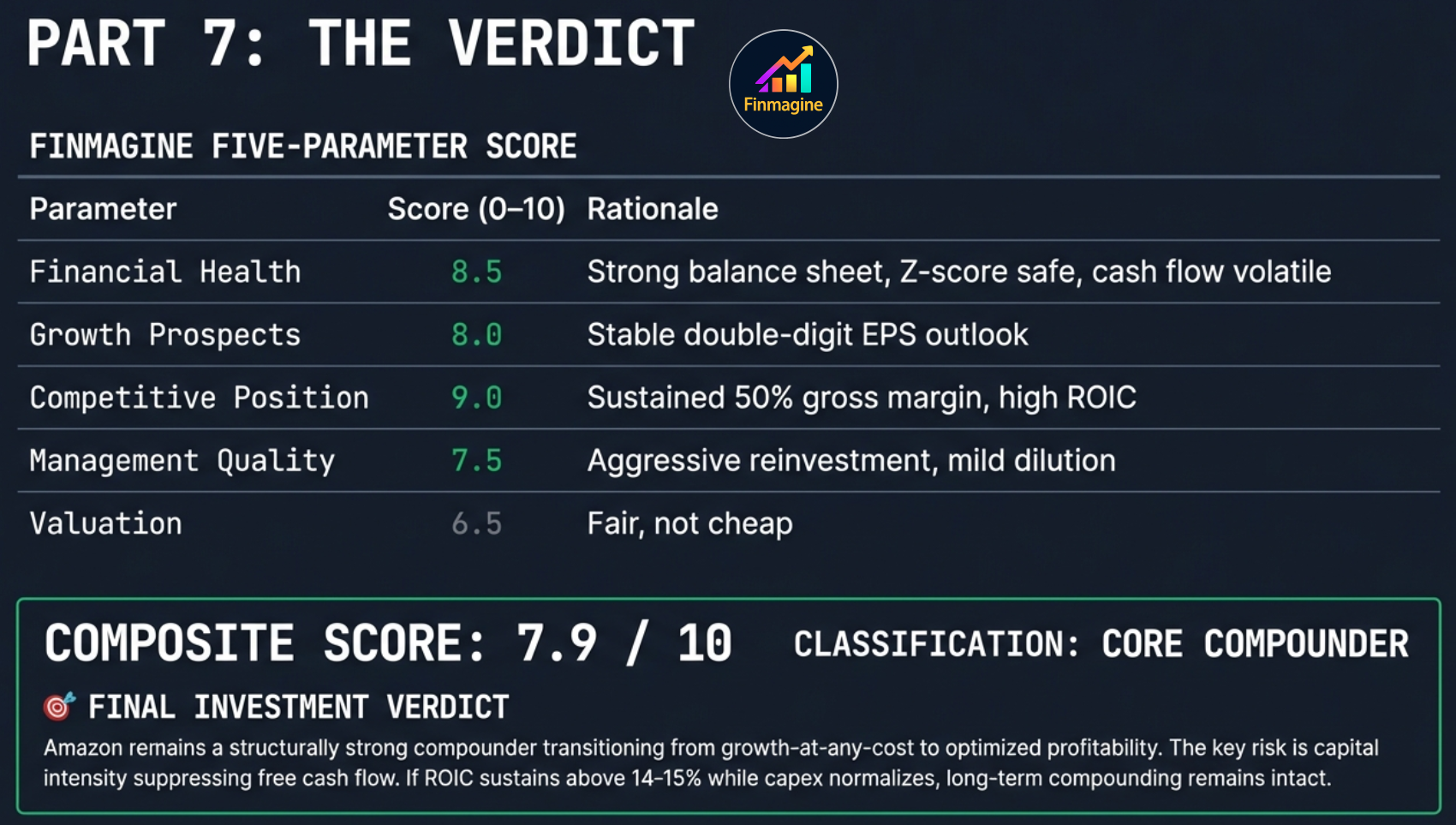
The AMZN analysis uncovers a paradox: ROIC 14.23% vs WACC 11.04% (positive value creation) alongside a 320x Price-to-FCF ratio and an 85% analyst price target spread — both distorted by a massive $131.8B AI & cloud CapEx cycle. Final score: 7.9/10, Core Compounder.
Complete 30-minute tutorial with the full Amazon case study, all 7 parts explained in depth, 57 interactive flashcards, NotebookLM audio deep dive, and YouTube video walkthrough.
Forensic Analysis Deep Dive → 57 Flashcards, Video & Audio Included
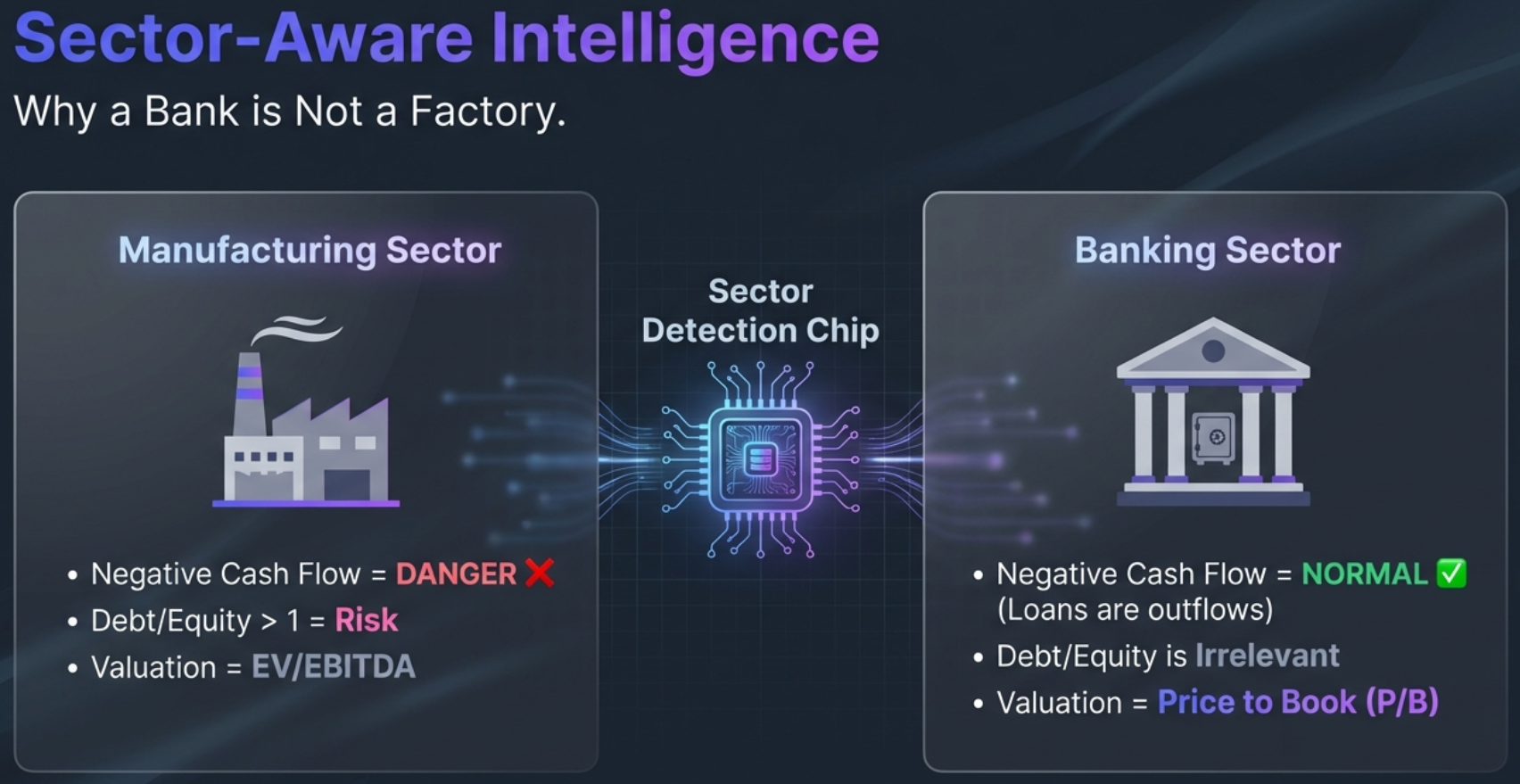
Generic stock screeners apply the same rules to every company. The AI Advisor has 18 distinct sector profiles, each with its own relevant metrics, disabled metrics, and customized thresholds. When the extension detects the company's sector from the Peer Comparison breadcrumb, everything downstream adjusts automatically.
| Sector | Primary Valuation | Special Handling |
|---|---|---|
| Banking | Price-to-Book (P/B) | NIM, GNPA, CASA; skip D/E; negative CFO is normal |
| NBFC | Price-to-Book (P/B) | NIM, GNPA, ROA; D/E threshold raised to 7.0 |
| IT Services | P/E Ratio | Attrition, TCV deal wins; skip D/E, Current Ratio |
| Pharma | P/E Ratio | R&D pipeline, ANDA filings, FDA risk, gross margin |
| Metals & Mining | EV/EBITDA | Cyclical handling; P/E unreliable |
| Infrastructure | EV/EBITDA | Interest coverage, order book-to-revenue |
| FMCG | P/E Ratio | Volume vs. price-led growth, brand premium |
| Real Estate | P/E + NAV | Pre-sales, collections; revenue lags activity |
Plus 10 more sectors: Telecom, Utilities, Chemicals, Auto, Capital Goods, Textiles, Consumer Durables, Insurance, Healthcare, and a General fallback.
Before GPT even sees the data, the extension's analysis engine computes insights that don't exist on the Screener.in page:
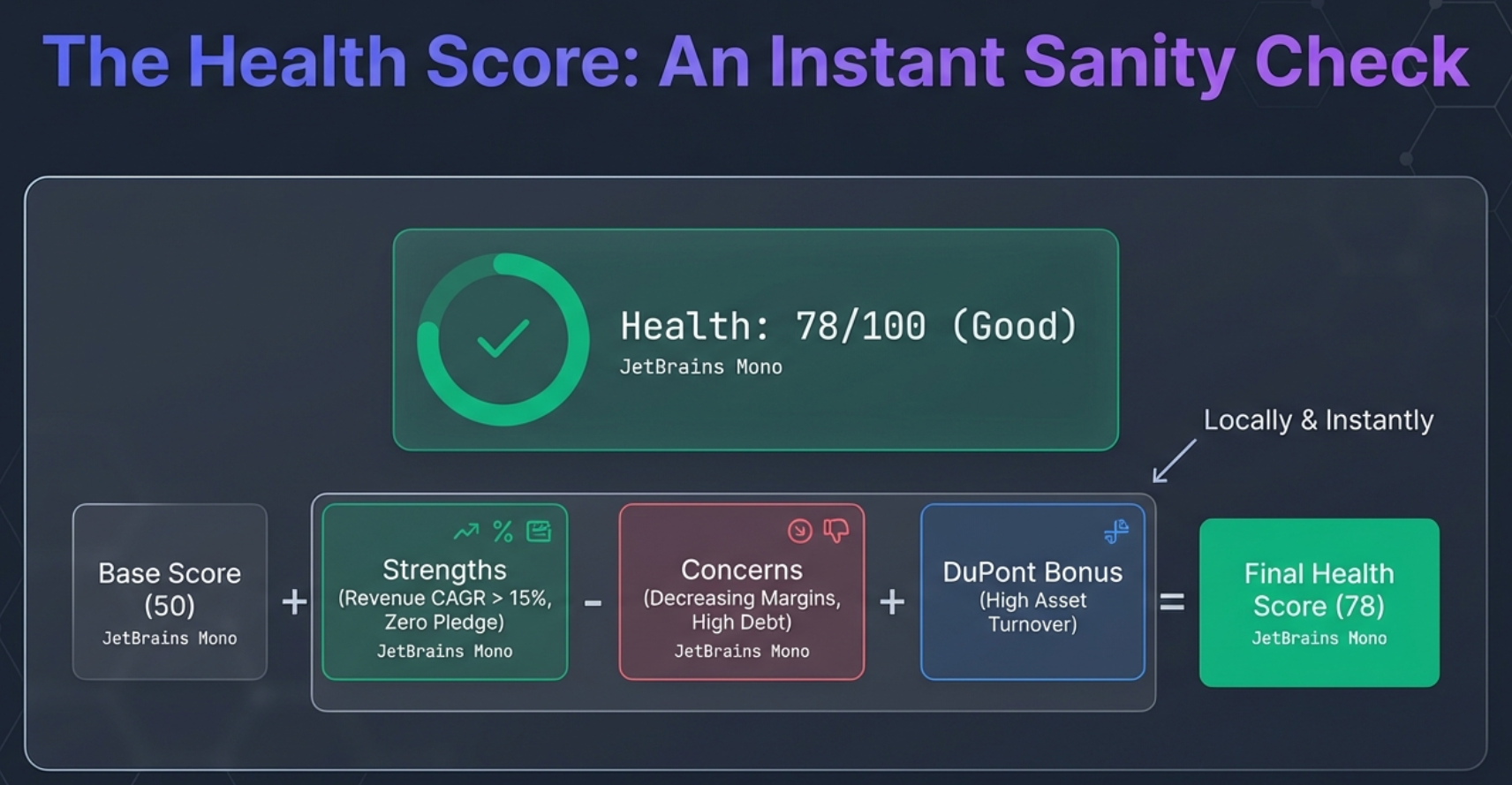
Starts at 50 (neutral). Adds bonus points for strong revenue/profit CAGR, high ROE/ROCE, positive cash flow, debt-free status, and sector-specific metrics. Deducts for each concern identified. Color-coded badge: Excellent, Good, Average, Below Average, Poor.
Revenue, Profit, and EPS growth rates at 1-year, 3-year, 5-year, and 10-year horizons. No manual calculation needed — the extension pulls start and end values from the tables automatically.
ROE = Net Profit Margin × Asset Turnover × Equity Multiplier. Reveals whether returns are driven by genuine profitability, operational efficiency, or financial leverage. A 25% ROE from leverage is very different from one from margins.
Sector-aware valuation assessment using the right metric for each industry — P/E for IT, P/B for banks, EV/EBITDA for metals. Compares current multiples against 5-year median and peer benchmarks.
Automated identification across growth, profitability, leverage, cash flow, and shareholding dimensions. Each finding feeds into the health score and is included in the prompt for GPT context.
Up to 12 quarters of concall transcripts (with separate Transcript, PPT, and Recording links), annual reports, credit ratings, and announcements — all URLs extracted and ready for Deep Research.
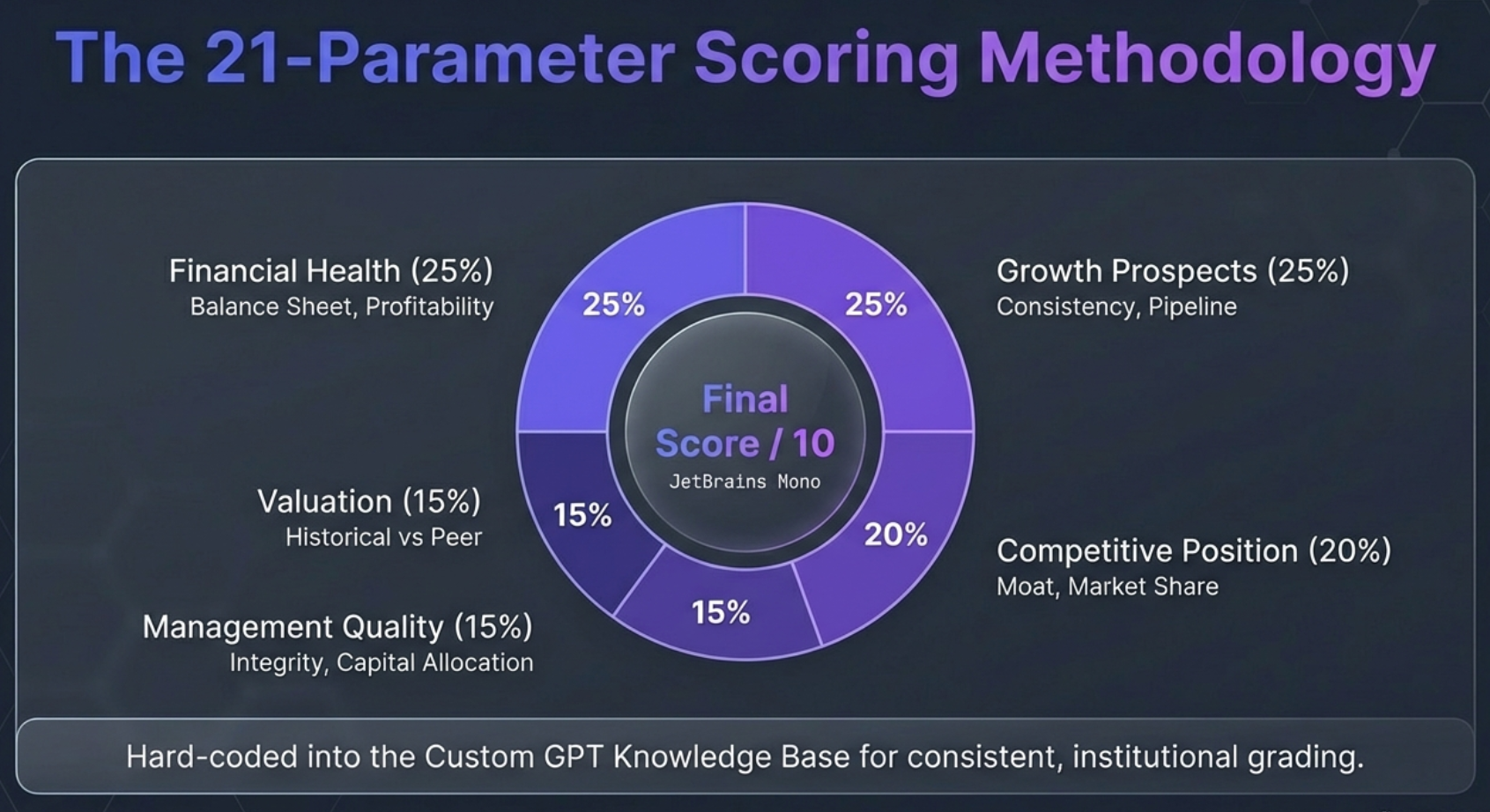
The Custom GPT doesn't produce ad-hoc analysis. It follows the Finmagine Five-Parameter Weighted Scoring Framework — hard-coded into its knowledge base for consistent, institutional-grade output. This framework evolved from Finmagine's Ranking Methodology, the same battle-tested system used to evaluate 71+ companies across the platform:
| Parameter | Weight | What It Measures |
|---|---|---|
| Financial Health | 25% | Balance sheet strength, profitability metrics, cash flow generation |
| Growth Prospects | 25% | Historical CAGR consistency, future potential (TAM), business scalability |
| Competitive Position | 20% | Market share leadership, economic moats, industry structure |
| Management Quality | 15% | Leadership track record, capital allocation, corporate governance |
| Valuation | 15% | Current multiples, historical context, peer comparison |
Valuation is deliberately weighted at only 15%. The framework prioritizes business quality (Financial Health + Growth + Competitive Position = 70%) over the price you're paying. A great company at a fair price will compound wealth over time. A mediocre company at a cheap price is often cheap for a reason.
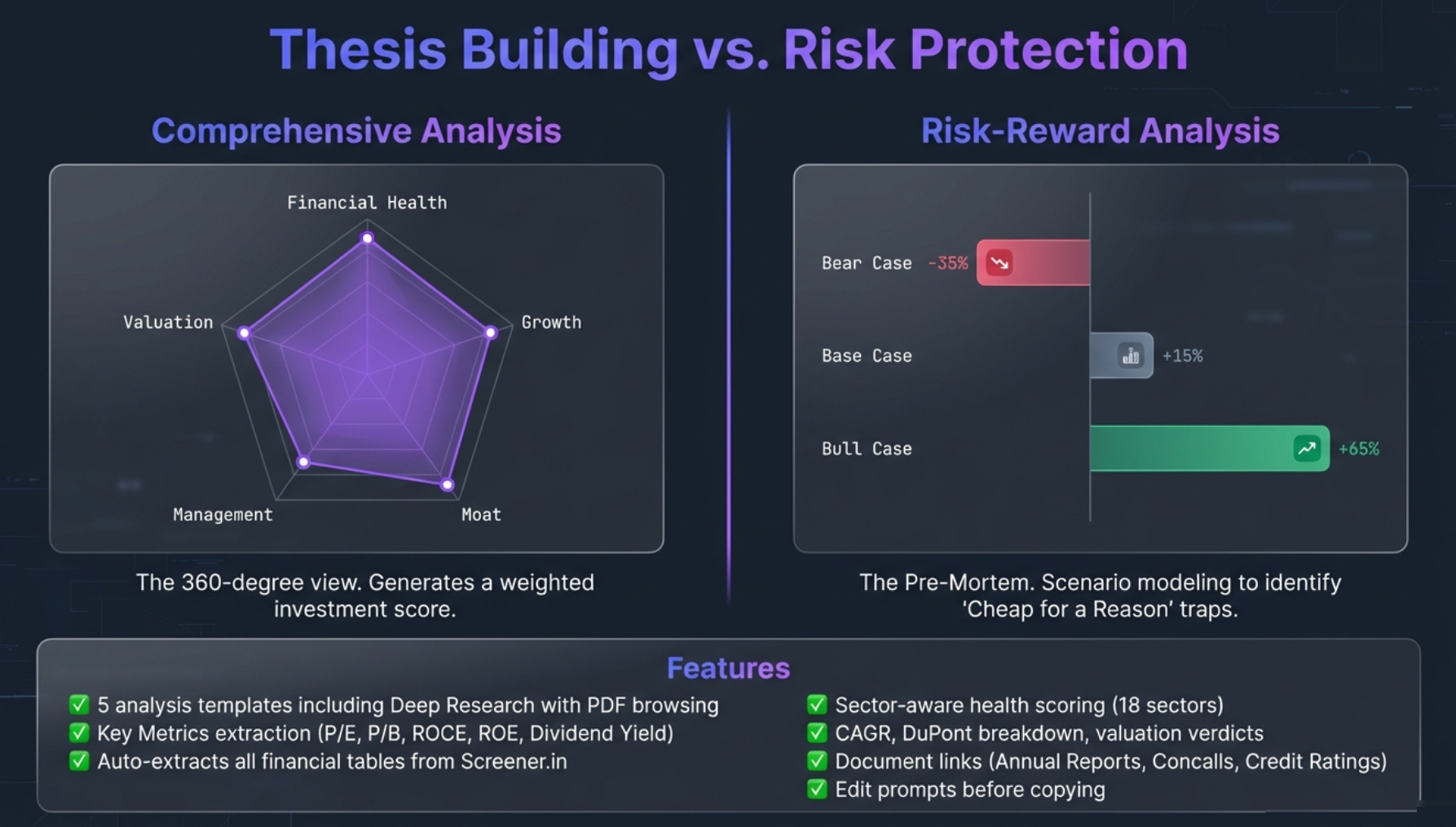
Each parameter is scored 2-10. The weighted composite determines the verdict: 8.0-10.0 Exceptional, 7.0-7.9 Strong, 6.0-6.9 Above Average, 5.0-5.9 Average, Below 5.0 Below Average. Every analysis concludes with an investment classification (Core Portfolio Compounder, Tactical Opportunity, or Watchlist) and position sizing guidance.
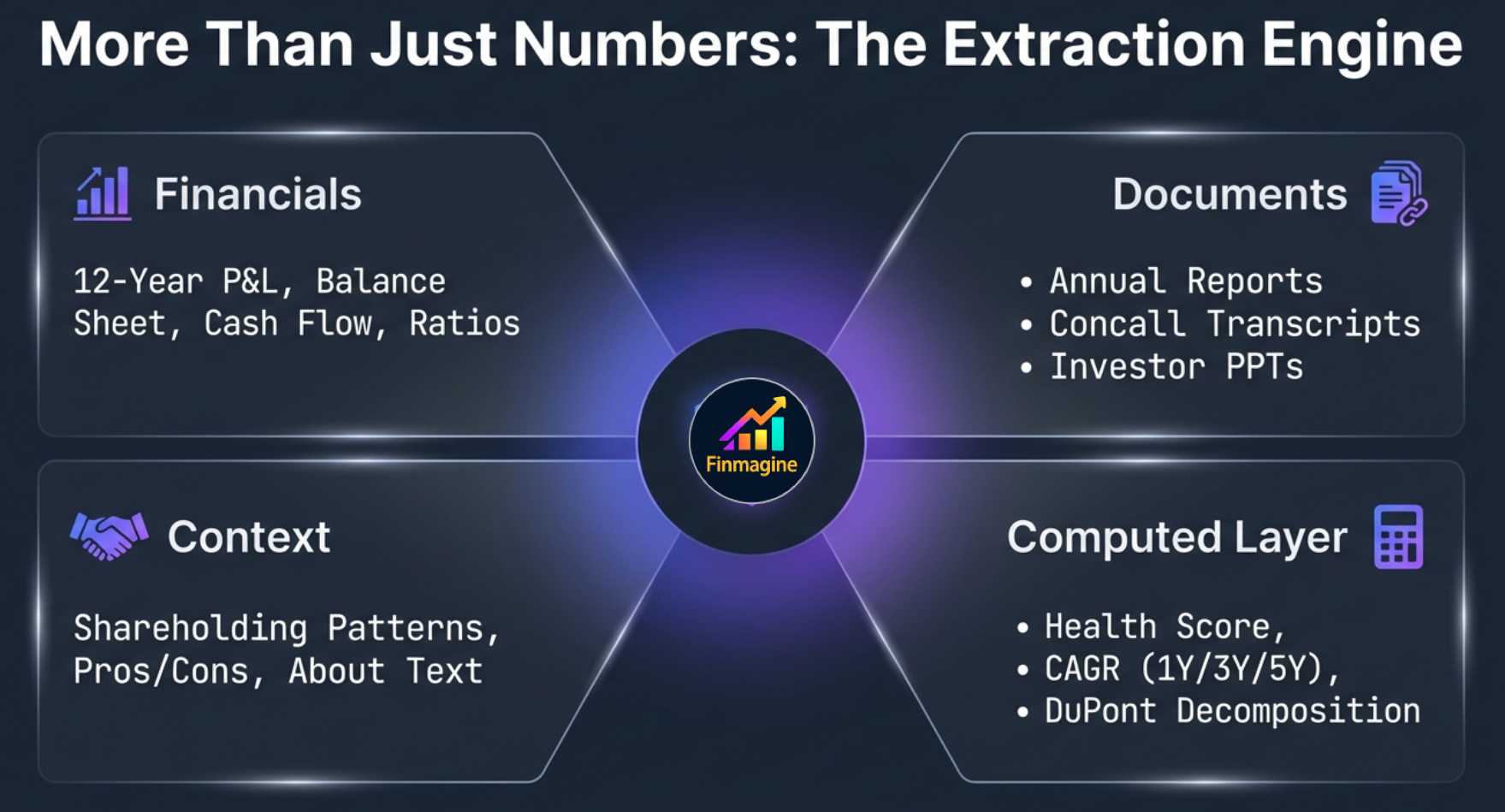
P/E, P/B, Price, Market Cap, ROCE, ROE, Dividend Yield, Debt/Equity, Book Value, 52-week High/Low, and more from the top ratios section.
Incremental ROCE (ΔOperating Profit ÷ ΔCapital Employed over 3 years) included in every prompt — the one ratio that separates true compounders from melting ice cubes.
6 complete tables: Annual P&L (12 years), Balance Sheet, Cash Flow, Ratios, Shareholding Pattern, and Quarterly P&L (11 quarters).
About section, Pros & Cons, Sector & Industry classification from Peer Comparison breadcrumb, BSE/NSE codes.
Annual Reports, Concall Transcripts (12 quarters with separate Transcript/PPT/Recording links), Credit Ratings, Announcements.
Replace hours of manual due diligence with a structured, repeatable, sector-aware research workflow. Run Comprehensive Analysis on your shortlist, Deep Research on your top picks.
Use the extension as a rapid first-pass filter. The health score and pre-computed CAGRs save time. The structured prompt ensures consistent analytical coverage across your universe.
Learn institutional-grade analysis methodology by seeing it applied to real companies. The Five-Parameter Framework, DuPont decomposition, and sector-aware thinking are core curriculum concepts brought to life.
Generate structured research as a starting point for stock write-ups. The Management Quality template provides unique "Promise vs. Delivery" content that readers love.
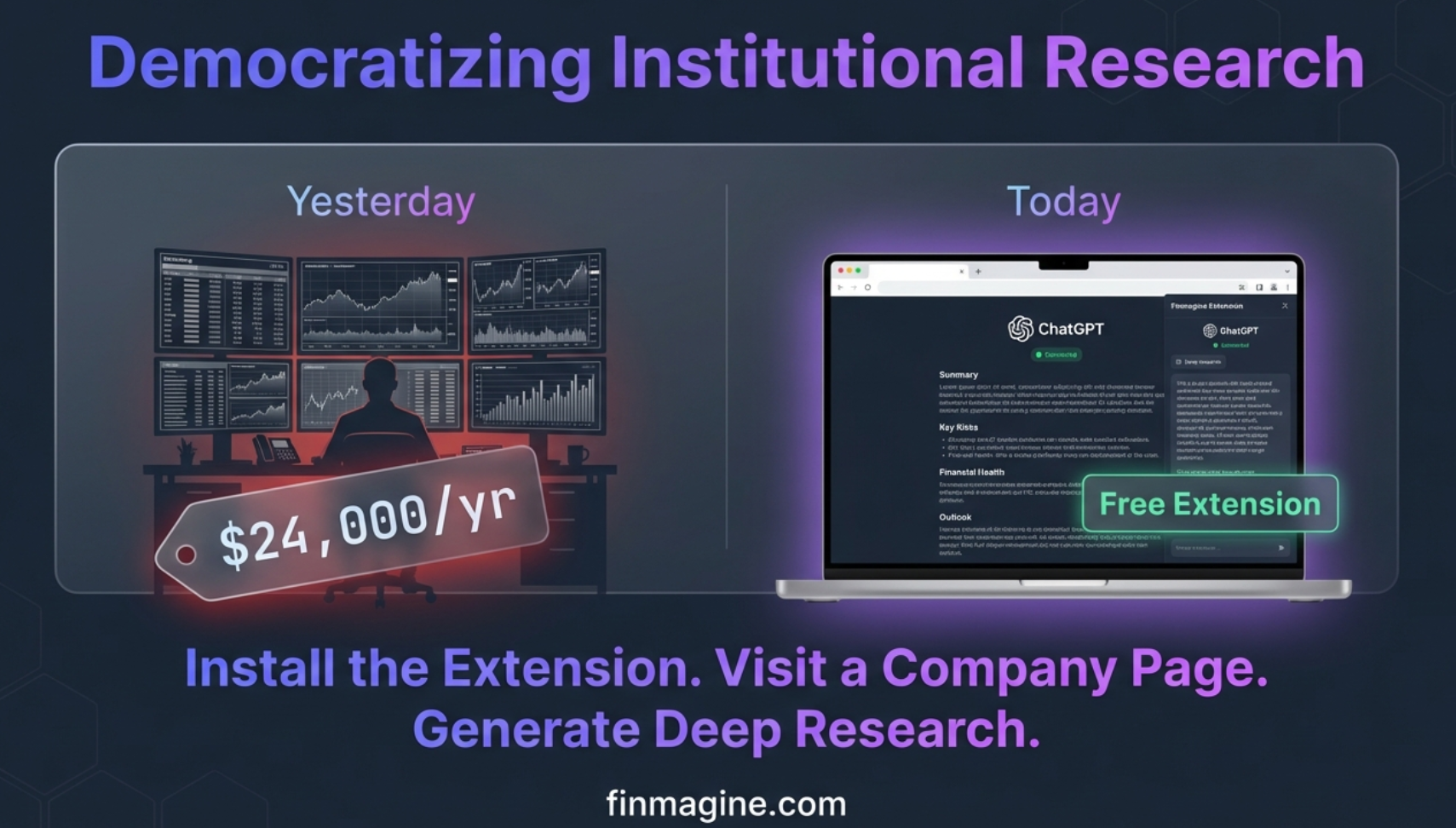
The information edge is gone — everyone sees the same Screener.in data. The analytical edge is collapsing — the AI Advisor automates what institutions do with dedicated teams. The behavioral edge remains — and that's the one edge AI can't replace.
AI gives you intelligence. Discipline builds wealth.
Everything you need to master the AI Advisor extension:
The featured US template in depth. 7-part quantitative framework, Amazon case study (Z-Score 5.06, F-Score 5/9, ROIC-WACC spread +3.19%, $131.8B CapEx paradox, Five-Parameter Score 7.9/10). Video walkthrough, audio deep dive, and 57 flashcards.
Complete tutorial for the AI Advisor on stockanalysis.com. Covers 10-page parallel fetch, Altman Z-Score, Piotroski F-Score, ROIC-WACC spread, 145 GICS industries, 4 templates, and real case studies with Amazon, Berkshire Hathaway, and PDD Holdings.
The definitive tutorial covering the architecture, all 7 templates (including Forensic Governance and Peer Comparison), unit economics analysis, sector-aware intelligence, health scoring, DuPont ROE, the 21-parameter methodology, and real company examples (TCS, HDFC Bank, Polycab). Includes video guide, audio deep dive, and 72 interactive flashcards.
New in v2.4.0. The 5-analyst quantified integrity framework for Indian stocks. Covers RPTs as % of revenue, promoter pledging multi-year trend tables, CFO/PAT ratio analysis, earnings call question avoidance rates, capex ROI audit. 20 flashcards.
New in v2.4.0. Auto-detects up to 8 sector peers from Screener.in, fetches live financial snapshots (P/E, ROCE, OPM, growth, incremental ROCE), and builds a 4-analyst head-to-head comparison. Full TCS vs IT sector case study. 18 flashcards.
New in v2.7.0. The most philosophically rich template in the extension. Jhunjhunwala, Pabrai, Mukherjea, Andrade, Maheshwari, and Graham each independently analyse any Indian stock from Screener.in — structured verdict, conviction sentence, biggest concern, key metric, and characteristic quote. Full Uno Minda case study: Consensus BUY, Andrade Strong Buy vs Graham Sell. 25 flashcards.
New in v2.8.0. Two features: (1) Ask Anything template — type any question, Claude reads all concall transcripts and annual reports, returns citation-anchored FINDING blocks. Tested on Innova Captab: 11 findings about Jammu capacity expansion from 3 quarters of concalls in under 2 minutes. (2) Manual Peer Selection — override Screener's GICS-based peers with custom NSE codes. Fixes wrong groupings like Innova Captab getting Divi's/Cipla instead of Akums/Windlas. 22 flashcards.
New in v2.9.0. Built from a ValuePickr community request. An 8-part macro-thematic brief: industry structure, dominant theme + live-cited TAM, policy dependency (1–5 rating), tailwinds & headwinds with severity, historical cycle analysis, global analogues with peak valuations, bear case scenarios with quantified earnings impact, and "Buy the company vs Buy the theme" final verdict. Tested on KEI Industries: W&C TAM ₹4.19 lakh crore by 2034, Policy Dependency 2/5, China analogue at PE 40-50x. Five-Parameter Score 8.50/10. Unlike every other template — the AI is directed to do live web research, not just analyse the extracted data. 25 flashcards.
New in v2.11.0. The most comprehensive India template. An 8-part institutional framework: Financial Health (Altman Z-Score, Piotroski F-Score), Growth Quality (revenue vs earnings vs cash flow), Competitive Positioning (moat type, ROIC trend), Unit Economics (contribution margin, operating leverage), Management Quality (capital allocation, CFO/PAT integrity), Valuation (P/E + EV/EBITDA percentile), Risk-Reward (bear/base/bull with probabilities), and Five-Parameter Score. Reads annual reports, investor presentations, and earnings call transcripts. Full Polycab India case study.
New in v2.11.0. Operational intelligence beyond financial statements. Extension assembles KPI data from Screener.in — capacity utilisation, realisations per unit, volume growth vs price growth, working capital turns, channel mix, and segment-level margins — then feeds it to the AI for a deep operating analysis. Identifies whether growth is volume-led or price-led, detects margin pressure early, and builds a complete picture of business health before it shows in reported numbers. Full Polycab & HDFC Bank case studies.
New in v2.14.0. The AI Advisor panel now appears on Value Research Online fund pages with three new mutual fund templates. This series intro explains all three — Deep Analysis, Active vs Index, and Portfolio Fit — and includes a decision tree for choosing the right one based on your goal. Start here.
New in v2.14.0. The Deep Analysis template audits a fund across seven SEBI-relevant dimensions: consistency, risk-adjusted returns, alpha decay as AUM grows, benchmark integrity (TRI vs PRI), downside protection in bear markets, manager behaviour/style drift, and forward viability. PPFAS Flexi Cap case study. Delivers a Suitable / Conditionally Suitable / Not Suitable verdict.
New in v2.14.0. Complete end-to-end worked example of the Portfolio Fit template. Follows investor Priya evaluating Nippon India Small Cap Fund against her 3-fund portfolio. Full AI output for all 5 analysis dimensions, Hold verdict, sensitivity analysis, and the 3-template due diligence sequence. Read this before running your first Portfolio Fit analysis.
New in v2.17.0. Forensic DRHP/RHP analysis for IPOs and recently listed companies. 7 sections: Business Reality Check, Financial Forensics (pre-IPO window-dressing flags), Promoter & Management Audit (OFS%, salary, pre-IPO exits), Use of Proceeds (growth vs exit funding), Valuation Sanity Check (vs real named peers), Risk Factor Triage (company-specific only), IPO Verdict. Requires DRHP/RHP PDF uploaded to Claude. Full tutorial with 15 flashcards.
New in v2.17.0. Forensic Annual Report scan for any listed Indian company. 7 sections: Earnings Quality Scan, Balance Sheet Stress Test, Cash Flow Integrity (PAT vs CFO 3 years), Related Party Audit (named entities and amounts), Auditor Signals (tenure, qualifications, KAMs), Governance & Promoter Behaviour. Closes with Red Flag Scorecard: N/18 flags, 🟢 CLEAN / 🟡 WATCH / 🔴 CAUTION, most critical finding, one concall question. Annual Report link auto-injected by AIA. Full tutorial with 15 flashcards.
New in v2.16.0. The Guidance Tracker now adds a Category column (Revenue / Margin / Capex&Project / Strategic) so you can see exactly where management is reliable and where they slip. Section 2 closes with a named Credibility Pattern archetype — Conservative Promiser, Reliable Executor, Optimistic Narrator, or Erratic — with investment implication and category-specific trust discounting. Full worked example with sample Guidance Tracker output.
New in v2.16.0. Every growth trigger in the Deep Research template now carries a conviction tag — 🔵 VISIBLE (confirmed from actuals), 🟡 GUIDED (stated by management), 🟢 OPTIONALITY (unpriced possibility). The section closes with a Trigger Scoreboard: Dominant Theme, Trigger Density, and Re-Rating Probability. Full worked example with tagged trigger table and sample Scoreboard output.
New in v2.15.0. A 5-section structural intelligence template: chain positioning (where in Raw Material → Platform hierarchy), full chain map from raw material to end consumer with margin benchmarks, pricing power chokepoints, vertical integration trajectory with earnings inflection year, and 10-year disruption exposure. Closes with a Chain Verdict — Structurally Advantaged / Neutral / Vulnerable. Full worked example with chain map and chokepoint analysis.
Complete transparency on data handling. See our zero-collection guarantee and understand exactly how the extension processes data locally in your browser.
The AI Advisor pairs naturally with our other free Chrome extensions — each solves a different part of the research workflow.
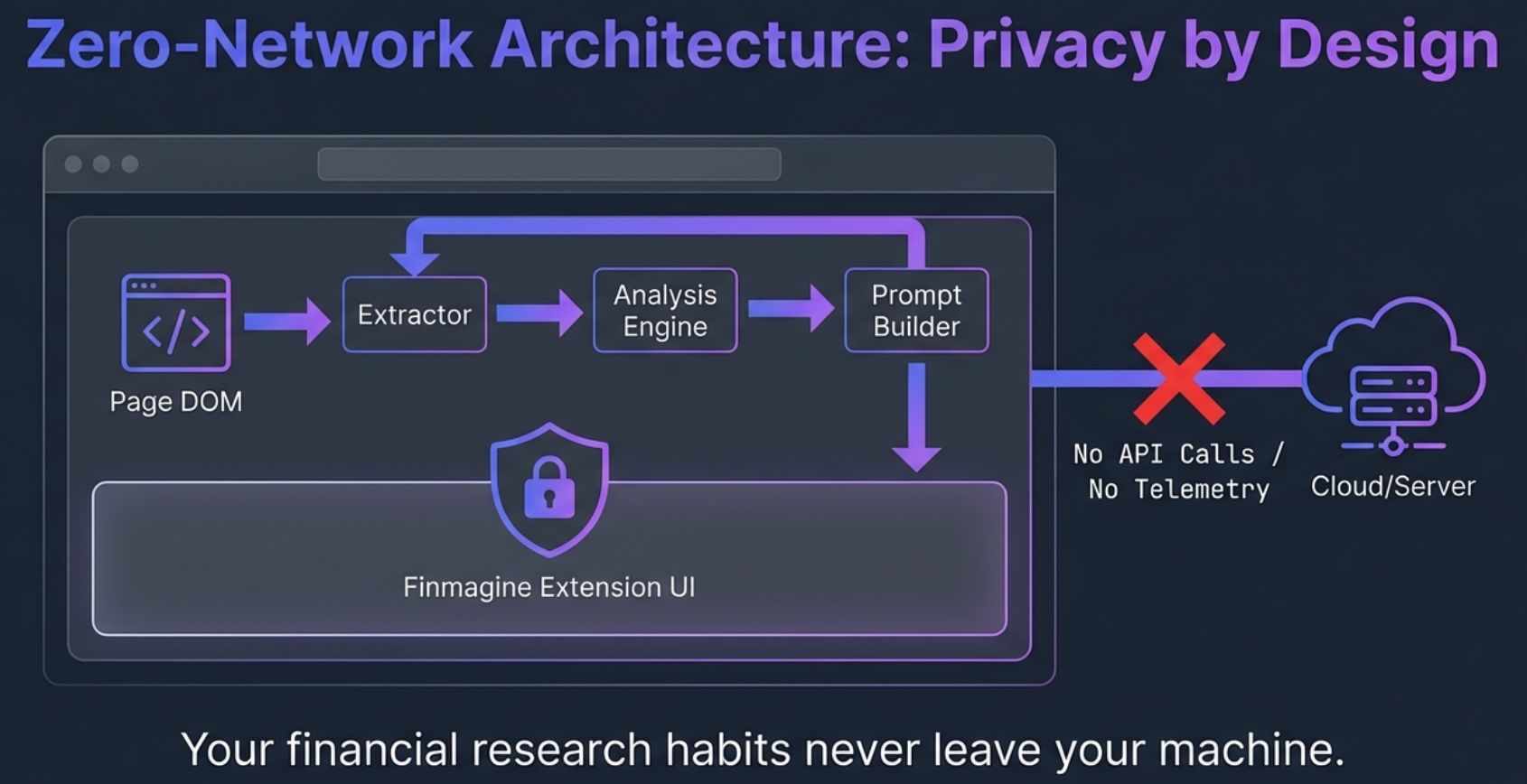
Your research stays private. Prompts, AI conversations, and analysis are generated locally and sent only to the AI platform you choose (ChatGPT, Gemini, etc.) — never to Finmagine servers.
Yes! 100% free with no trials, subscriptions, or hidden costs. We built this to democratize institutional-grade research for every Indian investor.
The AI Advisor doesn't just chat — it extracts all financial data from the Screener.in page, runs sector-aware analysis with 18 industry profiles, computes health scores and DuPont decomposition, and assembles everything into a structured prompt optimized for the Finmagine Custom GPT. The GPT has the Five-Parameter scoring methodology baked into its knowledge base. You can't get this quality by just asking ChatGPT "analyze TCS."
There are four pre-configured destinations, all loaded with Finmagine's 21-parameter analysis methodology and Five-Parameter scoring framework:
All four produce institutional-grade analysis. The "best" one is whichever AI you already have a subscription to.
Yes. The prompt includes real BSE filing URLs for concall transcripts, investor presentations, and annual reports. When you paste it into the Custom GPT (which has web browsing capability), it opens and reads those documents as part of its 9-part forensic analysis. This takes 15-30 minutes because thoroughness requires time.
Yes. The extension supports both Screener.in (Indian stocks, 7 templates including Forensic Governance and Peer Comparison) and stockanalysis.com (US/Global stocks, 4 templates including the featured Forensic Analysis). It activates automatically on screener.in/company/* and stockanalysis.com/stocks/* pages.
No registration required. Install and start using immediately.
Chrome and all Chromium-based browsers (Edge, Brave, Opera) on desktop — Windows, macOS, Linux, and ChromeOS.
Mobile devices are not supported. Google Chrome does not support extensions on Android or iOS/iPadOS — this is a platform limitation, not specific to this extension. Google has confirmed this in their own support forums: "Chrome extensions is only supported for the Chrome desktop web browser. And not for iOS and Android." You will need a desktop or laptop to use the Finmagine AI Advisor. — Full reference with all sources →
Yes. The Edit button toggles the prompt between read-only and editable mode. Add custom instructions, focus areas, or specific questions before pasting into GPT.
The best place is the ValuePickr community thread — other investors are there, questions get answered, and feature requests are tracked. You can also use the Chrome Web Store reviews section or the Finmagine contact page.
Install the extension. Visit a company page on Screener.in or stockanalysis.com. Generate institutional-grade research in minutes.
No credit card required • No registration • 100% Free Forever